---
title: "Acrylic vs Melamine Serving Tray: Which Lasts?"
description: "Acrylic vs melamine serving tray for hospitality buyers: heat, food safety, scratch life, branding, and cost — cited specs plus each material's failure mode."
category: "Comparison"
author: "Amy Liu"
authorCredential: "Client Account Manager at Wetop Acrylic — coordinating B2B orders from first inquiry through delivery since 2020, 500+ custom projects handled"
datePublished: 2026-07-08
dateModified: 2026-07-08
primaryKeyword: "acrylic vs melamine serving tray"
url: https://wetopacrylic.com/guide/acrylic-vs-melamine-serving-tray-buyer-guide/
---
## Which failure mode does your tray service reach first? {#short-answer}
In the acrylic vs melamine serving tray decision, melamine wins on price and break resistance while acrylic wins on clarity, branding, and premium feel. A melamine tray costs less per piece and shrugs off drops that would crack acrylic, which is why cafeteria and poolside operations lean on it. A cast acrylic tray reads high-end, holds a logo cleanly under a glass-like surface, and keeps that finish longer when hand-washed. The decision is not "which is better" — it is which failure mode your service reaches first.
That framing matters because buyers usually ask the wrong question. I get this comparison across my desk regularly, and the deciding factor is rarely safety or even raw toughness — both materials are food-safe at serving temperatures and both survive normal handling. What actually settles it is *how the tray looks after a year of a specific service*, and that answer runs opposite for the two materials: melamine survives the drop but loses its looks to knife scratches and dishwasher wear, while acrylic keeps its looks but needs gentler handling. This guide breaks the choice down the way we walk B2B buyers through it — heat, food safety, appearance life, branding, cost, and lifespan — with every material fact cited so a buyer can verify it, plus where stainless and wood fit as the other two hospitality contenders.
---
## Quick-reference comparison table {#comparison-table}
Acrylic and melamine sit at opposite ends of the serving-tray tradeoff: melamine is the durable, low-cost workhorse; acrylic is the premium, brandable showpiece. The table below lines up the two head-to-head across the eight decision axes hospitality buyers actually weigh, with the third-party-sourced numbers that back each row. Read it top to bottom, then jump to the section that decides your program.
| Decision axis | Acrylic (cast PMMA) | Melamine (melamine-formaldehyde) |
|---|---|---|
| **Clarity / look** | Optically clear, glass-like; also available frosted or colored | Opaque only; matte or gloss color, never see-through |
| **Weight** | Light; density about 1.2 g/cm³[^makeitfrom-pmma] | Slightly heavier, denser feel |
| **Break resistance** | Brittle — cracks or chips on hard drops | Excellent — near-unbreakable in normal service |
| **Heat / dishwasher** | HDT about 96°C; below the 180°F (82°C) high-temp rinse[^makeitfrom-pmma][^thermoworks] — hand-wash or low-temp cycle | Built for high-temp warewashers; never heat food or exceed 160°F (71°C)[^fda-melamine] |
| **Food safety** | Compliant per FDA 21 CFR 177.1010[^ecfr-177] | NSF-listed A5-grade dinnerware (NSF); not microwave-safe[^fda-melamine] |
| **Custom branding** | Second-surface print + laser etch under a clear top — never wears off | Surface print only, sits on the wear layer, dulls over time |
| **Scratch / stain** | Scratches if abused; keeps clarity when hand-washed | Steak knives cut the surface; dark foods can stain scratches |
| **Typical commercial lifespan** | Years when hand-washed; replaced when scratched or clouded | 12–24 months in heavy service before appearance forces replacement[^katom-replace] |
| **Recyclability** | Thermoplastic — can be remelted | Thermoset — cannot be remelted or curbside-recycled[^recycledplastic-melamine] |
| **Best fit** | Amenity, room-service, retail, bar, corporate-branded | Cafeteria, poolside, buffet, high-volume drop-heavy service |
The pattern is consistent: every row where melamine wins is about *surviving abuse cheaply*, and every row where acrylic wins is about *looking premium and carrying a brand*. Match the winning column to what your service actually needs, not to a generic "most durable" instinct.
---
## What each material actually is {#what-they-are}
Acrylic and melamine are chemically unrelated plastics that behave in opposite ways under heat. Acrylic is polymethyl methacrylate (PMMA), a clear thermoplastic that can be melted and reshaped. Melamine dinnerware is melamine-formaldehyde, an opaque thermoset that cures into a permanent, irreversible shape and cannot be remelted.[^recycledplastic-melamine] That single difference — thermoplastic vs. thermoset — drives almost everything downstream: clarity, heat behavior, branding, and end-of-life.
Acrylic (PMMA) is the same polymer sold under the trade names Plexiglas, Perspex, and Lucite.[^pmma-tradenames] It is optically clear, takes a diamond-polished edge, and can be cast in thick gauges — the reason a quality acrylic tray has that heavy, glass-like presence. Because it is a thermoplastic, it softens with heat, which is both how we thermoform it and why it is not a high-temp-dishwasher material. Melamine, by contrast, is molded from a melamine-and-formaldehyde resin that hardens as it cures and stays hard: white, tasteless, odorless, with strong chemical and heat resistance,[^recycledplastic-melamine] which is exactly why the commercial-foodservice world adopted it for nearly unbreakable plates, bowls, and trays. Neither material is "better" as a substance — they are built for different jobs. When a buyer tells me the tray is going into poolside or cafeteria service, melamine is often the honest answer even though we do not make it; when the tray carries a logo a guest is meant to notice, acrylic is the one that protects that investment.
---
## Heat and dishwasher performance — the operational dividing line {#heat-dishwasher}
Melamine handles a commercial high-temp dishwasher; decorative acrylic does not. A high-temp commercial warewasher runs a final sanitizing rinse near 180°F (82°C) to reach the 160°F (71°C) dish-surface temperature the food code requires.[^thermoworks] Cast PMMA acrylic has a heat-deflection temperature of about 96°C at 1.82 MPa,[^makeitfrom-pmma] so repeated high-temp cycles put it close enough to its softening range to risk warping and crazing over time. Melamine is engineered for that cycle; acrylic is a hand-wash or low-temp-sanitizing item.
This is the single most operationally important difference in the whole comparison, and it is the one I see buyers overlook most often. When trays cycle through a kitchen warewasher between every service — a restaurant, a banquet operation, a buffet line — melamine's high-temp tolerance is a genuine advantage, and putting decorative acrylic into that same rack is asking for a clouded, warped tray within months. But a huge share of serving trays never see a high-temp warewasher at all: hotel amenity and room-service trays get wiped or hand-washed, retail and bar-cart trays get spot-cleaned, corporate-gift trays get gentle care by design. For those, acrylic's dishwasher limit is a non-issue, and its clarity and branding win the day. The rule I give buyers is simple: if the tray lives in the kitchen dish pit, lean melamine; if it lives in the guest's hands or on a display surface, acrylic's ceiling never comes into play.
One shared limit applies to both: neither material is microwave-safe. Acrylic softens well below microwave-reheat temperatures, and the FDA is explicit that melamine dinnerware should never be used to heat food, because heating — especially highly acidic food to 160°F (71°C) or above — increases how much melamine migrates out of the plastic.[^fda-melamine] For a *serving* tray, this rarely matters, since trays carry plated food rather than reheat it. But it is worth stating plainly so no one specs either material as a heat-and-serve piece.
The 82°C high-temp dishwasher rinse is the line that separates the two: melamine is built to clear it, cast acrylic's 96°C heat-deflection temperature sits close enough that repeated cycles risk warping.
---
## Food safety — both compliant, with different rules {#food-safety}
Both acrylic and melamine are food-contact safe for serving, under different regulatory frameworks. Rigid and semirigid acrylic plastics are covered for food contact under FDA 21 CFR 177.1010, which permits acrylic and modified-acrylic plastics as food-contact articles when at least 50% of the polymer derives from listed acrylic or methacrylic monomers.[^ecfr-177] Commercial melamine dinnerware is manufactured and third-party certified to NSF food-safety standards as A5-grade material (an NSF designation, not an FDA one), the grade required in commercial kitchens. Neither is microwave-safe.
The practical distinction is about *temperature*, not the material itself. Melamine's food-safety story carries a firm ceiling: the FDA states melamine tableware should not be used to heat food, and that migration of melamine into food rises when acidic food is heated to 160°F (71°C) or higher.[^fda-melamine] At normal serving temperatures the migration is negligible — FDA's own worst-case estimate for cold juice held about 15 minutes is well below its acceptable level — so melamine is entirely safe as a *serving* surface, just not a heating one. Acrylic carries no equivalent acidic-food heating flag; its limit is mechanical (it softens with heat) rather than chemical migration. For the vast majority of serving-tray uses — plated food, cold amenities, dry goods, bar service, retail display — both materials clear the food-safety bar comfortably. The one spec I always confirm with a buyer is that the *decoration* is food-safe too: on printed acrylic trays we print second-surface (under the tray, viewed through it) so ink never contacts food, and on any tray meant for direct food contact we keep the food-side surface undecorated. We treat that as a default, not an upgrade, so a buyer never has to specify it.
---
## Appearance life — the failure mode buyers underrate {#appearance-life}
Melamine rarely breaks; it wears out looking tired. The industry's own replacement guidance is the tell: realistic melamine service life in heavy commercial use runs 12–24 months before visible surface degradation forces replacement,[^katom-replace] and that clock is driven almost entirely by appearance, not structural failure. Steak knives are melamine's primary enemy — their concentrated edge pressure cuts through the glazed surface,[^get-scratch] and once the surface is cut, dark foods like coffee, tea, and tomato sauce stain the scratches. Commercial dishwasher cycles add fine abrasion on top. The result reads as "dirty" to a guest long before the piece is actually unusable.
This is the failure mode buyers underrate, and it flips the durability question on its head. Melamine "wins" on durability if you define durability as *not breaking* — and it genuinely does, surviving drops that would shatter acrylic. But if you define durability as *still looking good enough to put in front of a paying guest*, melamine's advantage shrinks fast in knife-and-dishwasher service. Acrylic has the opposite profile: it is more brittle and will chip or crack on a hard drop, but its surface does not scratch from cutlery in normal use, and when it is hand-washed rather than run through an abrasive high-temp cycle, it holds its clarity for years. So the honest durability verdict is conditional. In a cafeteria with steak knives and a warewasher, a melamine tray and an acrylic tray might both need replacing in a similar window — melamine from scratches, acrylic from cracks — and melamine's lower unit cost wins. In an amenity or retail setting with gentle handling and no knives, acrylic keeps looking new far longer, and its higher unit cost amortizes over a much longer appearance life. Ask what abuses your tray actually takes, and the "more durable" material chooses itself.
---
## Custom branding — where acrylic pulls decisively ahead {#custom-branding}
For a branded tray, acrylic protects your logo in a way melamine cannot. A clear acrylic tray lets you print artwork on the second surface — the underside of the tray floor — so the design is viewed *through* the polished acrylic and the material itself becomes the protective layer. The print never touches food, never touches cutlery, and never wears off. Melamine takes surface printing too, but that print sits on the same glazed wear surface that scratches and dulls, so the branding ages at the same rate as the plate.
This is the axis where the two materials stop being close. When the tray is a brand touchpoint rather than a back-of-house workhorse, acrylic's decoration options are simply in a different class:
- **Second-surface printing.** Full-color artwork sealed under the clear top, giving a glossy depth effect that is genuinely hard to reproduce in any opaque material. Because it is under the acrylic, it survives washing and daily service intact — the reason it dominates our hotel-amenity and retail tray orders.
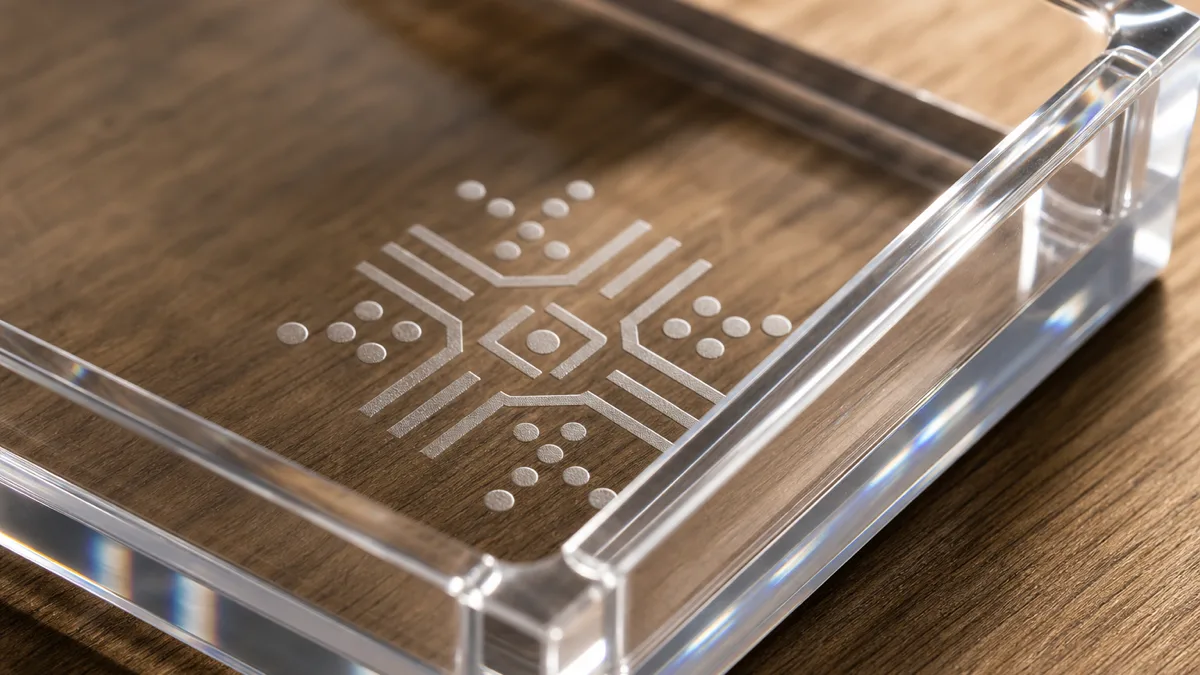
- **Laser etching.** A frosted logo cut into the surface that reads as understated and premium precisely because it does not shout. Etch depth has to be consistent across the mark, which is a quality gate worth checking on a sample; the full spec is in our [etched-logo acrylic tray spec guide](/guide/etched-logo-acrylic-trays-spec/).
- **Interchangeable inserts.** A printed insert card that drops under a clear tray floor, so seasonal or campaign artwork can change without re-tooling the tray — covered in our [acrylic tray bottom-insert spec guide](/guide/acrylic-tray-bottom-insert-spec/).
- **Color and finish.** Beyond clear, acrylic runs frosted, tinted, or mirrored to match a brand palette, while still holding a printed or etched mark.
Melamine's branding, by contrast, is essentially "printed color plate" — fine for a casual-dining house pattern, weak for a premium program where the tray itself is meant to signal quality. I've watched this decide the material more often than heat or cost: the moment a buyer's brief mentions a logo, a boutique feel, an amenity guests notice, or a retail shelf presence, that brief is quietly describing an acrylic tray. The bottom-print quality gates — watertight, bubble-free, color-accurate — are where these programs are won or lost, and we cover them in the [bottom-printed acrylic trays print-quality guide](/guide/bottom-printed-acrylic-trays-print-quality/). One amenity program integrated original artwork into a printed acrylic tray line, and the proof-and-sample loop caught color issues before production — the full walkthrough is in our [bespoke acrylic tray artwork case study](/case-studies/bespoke-acrylic-tray-artwork-integration/).
Second-surface printing under a clear acrylic floor: the artwork is viewed through the tray, so it never contacts food and never wears off — the branding advantage melamine cannot match.
---
## Cost — unit price vs. total cost of ownership {#cost}
Per piece, melamine is cheaper; over the program's life, the gap narrows. Melamine trays carry a lower unit cost, especially at stock sizes and high volumes, because they are injection- or compression-molded at scale from an inexpensive resin. Custom acrylic trays cost more per unit — they are cut, polished, printed or etched, and often assembled with finished corners. But melamine's shorter appearance life (12–24 months in heavy service)[^katom-replace] means you buy it more often, so the honest cost comparison is total cost of ownership across a few years, not the first invoice.
The way to actually decide this is to separate two buying situations. **Stock, high-volume, back-of-house service** — cafeteria trays, buffet trays, poolside — is where melamine's unit-cost advantage is real and hard to beat; the trays are commodities, appearance tolerance is lower, and molded melamine at scale simply costs less. **Custom, branded, guest-facing programs** are where acrylic's math works: the tray is part of the brand, the volumes are lower (often a 50–500 piece amenity or retail run), appearance life is long because handling is gentle, and a scratched melamine tray with a faded logo would undercut the very impression the program exists to create. In that second situation, quoting acrylic against melamine on unit price alone is the wrong comparison — we are pricing a brand surface against a commodity plate, and we say so when a buyer asks why our acrylic quote sits above a melamine one. And because custom acrylic is always quoted rather than sold at a fixed price, the real number depends on size, thickness, decoration, and quantity; the variables are the same ones we walk through in the [custom serving trays spec guide](/guide/custom-serving-trays-spec-guide/). One more cost note we raise on the first quote: we price landed cost including freight, not just FOB, and buyers should ask every supplier for the same basis. Acrylic's density is about 1.2 g/cm³,[^makeitfrom-pmma] so thickness decisions translate directly into shipping weight — a point that matters more on heavy custom acrylic than on thin molded melamine, and one we flag before a buyer overbuilds the base.
---
## Weight, feel, and break resistance {#weight-feel}
Melamine feels solid and survives drops; acrylic feels premium but is more fragile. Melamine's density gives it a reassuring heft in the hand and, more importantly, near-unbreakable toughness — it bounces where acrylic cracks, which is exactly why high-drop environments like cafeterias and poolside bars standardize on it. Cast acrylic, at a density of about 1.2 g/cm³,[^makeitfrom-pmma] can be built thick for a substantial, glass-like weight, but it stays a brittle thermoplastic that will chip or crack on a hard fall.
The nuance most buyers miss is that "premium feel" and "break resistance" are two different properties that acrylic and melamine split between them. Acrylic delivers the premium feel — the clarity, the polished edge, the cool weight of a thick base — that makes a tray read expensive in a guest's hands. Melamine delivers the break resistance that makes a tray survive a busy shift. You rarely get both in one material, which is why the environment decides. A rooftop bar handing trays across a crowded service well wants melamine's toughness; a spa amenity tray resting on a stone counter wants acrylic's look and will never be dropped. On the acrylic side, weight is also a spec to control deliberately, not maximize — a tray that is too thick becomes heavy to carry loaded and expensive to ship, and the base thickness math (weight rises directly with gauge) belongs in your spec conversation. Thicker is not automatically better; the [custom serving trays spec guide](/guide/custom-serving-trays-spec-guide/) works through where to put the visual mass without overbuilding.
---
## Where stainless and wood fit {#stainless-wood}
Acrylic and melamine are two of four common serving-tray materials; stainless steel and wood round out the field. Stainless is the most durable of all four — it survives high-temp dishwashers, drops, knives, and years of abuse — but it is opaque, utilitarian, and takes branding only as etch or engraving, so it fits back-of-house and industrial service more than guest-facing brand moments. Wood reads warm and premium like acrylic, but is porous, harder to sanitize, and cannot go through a commercial dishwasher at all, which limits it in regulated foodservice.
Slotting all four together makes the acrylic-vs-melamine choice clearer by showing what each material is really for. **Stainless** is the workhorse where appearance is secondary to indestructibility and hygiene — hospital trays, industrial catering, ware-return. **Wood** is the artisanal, natural-material choice for a rustic or high-end plated presentation, accepting the sanitation and dishwasher tradeoffs for the look. **Melamine** is the durable, colorful, break-proof commodity for high-volume casual service. **Acrylic** is the clear, brandable premium option for amenity, retail, bar, and corporate programs where the tray itself carries a message. If your shortlist has come down to acrylic vs. melamine specifically, you have usually already ruled out stainless (too utilitarian for a guest-facing brand piece) and wood (too high-maintenance for volume service) — which means you are really choosing between a premium branded surface and a durable commodity, and the earlier sections settle that. We build the acrylic end of this field across our [custom acrylic serving trays](/products/acrylic-trays/acrylic-serving-trays/) line, and the [acrylic trays hub](/products/acrylic-trays/) covers the full range of formats.
---
## Decision framework — which tray for which service {#decision-framework}
Match the material to the failure a given service actually causes. Trays that run through a high-temp kitchen dishwasher between services, or face steak knives and frequent drops, point to melamine's toughness and heat tolerance — replace them on the 1–2 year appearance cycle and move on. Trays that are guest-facing brand surfaces — amenity, room-service, retail, bar-cart, corporate gifting — handled gently and rarely dropped, point to acrylic's clarity, branding, and long appearance life.
I run new buyers through the same five questions, and they settle the choice in about a minute:
1. **Does the tray go through a high-temp commercial dishwasher?** Yes → strongly favors melamine (or stainless). No → acrylic is fully in play.
2. **Will steak knives be used directly on the tray surface?** Yes → melamine will scratch, acrylic resists cutlery marks but can be cut too; the question becomes whether food sits on a plate rather than the tray. Mostly plated → either works.
3. **Is the tray a brand touchpoint a guest is meant to notice?** Yes → acrylic, decisively, for second-surface print and etch. No / house-pattern only → melamine is fine.
4. **What is the drop risk?** High (crowded service, poolside, cafeteria) → melamine. Low (spa, boutique retail, gifting) → acrylic.
5. **What volume and appearance tolerance?** Very high volume, appearance-tolerant → melamine's unit cost wins. Lower volume, appearance-critical → acrylic's total cost of ownership wins.
When most answers point one way, that is the material. When they split — say, a high-volume amenity program that is guest-facing but also drop-prone — the tiebreaker is whichever failure the buyer cannot tolerate: a cracked tray in front of a guest, or a scratched logo. In my experience most premium hospitality buyers cannot tolerate the faded logo, which is why guest-facing programs skew acrylic even when melamine would survive more drops. Once it has narrowed to acrylic, [send us your tray brief](/contact/?source=acrylic-vs-melamine-serving-tray-buyer-guide) to pressure-test the spec — the sample tells a buyer more than any spec sheet.
---
## How to spec a custom acrylic tray if that is your pick {#spec-acrylic}
If the decision lands on acrylic, seven spec lines turn a vague request into an accurate quote. Most tray quotes stall on missing basics rather than hard questions — I chase these details on nearly every first inquiry — so pinning them down before writing to any factory produces a faster, tighter, comparable quote, and just as importantly, protects a buyer from a supplier quoting a cheaper build than they pictured.
The seven lines that matter:
1. **Dimensions, and which kind.** State outside or inside dimensions explicitly — a tray that must *hold* a 300 mm item is a different object than one that *measures* 300 mm.
2. **Base and wall thickness.** This drives both the premium feel and the shipping weight; state the numbers rather than "thick."
3. **Material grade.** Specify cast acrylic — it polishes to a cleaner edge and comes in the thick gauges a substantial tray base needs.
4. **Decoration.** Second-surface print, laser etch, insert card, or plain — with vector artwork if a logo is involved.
5. **Finish tier.** Mitered and diamond-polished corners for a premium program, or standard edges for a cost-driven one; this single line moves cost more than any other.
6. **Quantity and cadence.** Against our 50-piece MOQ, and whether this is a one-off test or a repeating program.
7. **Destination and terms.** So the quote can include freight from day one, on a landed basis you can compare like-for-like.
The wholesale path itself is shorter than most first-time buyers expect: a 50-piece MOQ per design, samples in 3–5 days, and production in 15–20 days, with every piece inspected before packing under our ISO 9001 quality system. The sample stage is where these programs are actually decided — it is the one moment a buyer holds the exact corner joint, edge polish, print quality, and clarity the production run will be measured against. For a branded tray program especially, I tell buyers to approve nothing from a render; the physical sample is the whole point of the exercise, and we ship it in days.
---
## How we sourced this comparison {#methodology}
The material claims in this guide are drawn from third-party standards, regulatory text, and materials data — not from internal Wetop testing. Acrylic's heat-deflection temperature (about 96°C) and density (about 1.2 g/cm³) come from published PMMA material data;[^makeitfrom-pmma] the commercial dishwasher final-rinse temperature (180°F / 82°C) from foodservice food-code guidance;[^thermoworks] acrylic's food-contact status from FDA 21 CFR 177.1010;[^ecfr-177] and melamine's food-safety limits, microwave guidance, and 160°F heating threshold from the FDA and NSF-grade dinnerware standards.[^fda-melamine] Melamine's commercial appearance life (12–24 months) and scratch behavior come from foodservice industry replacement guidance and melamine-care sources,[^katom-replace][^get-scratch] and its thermoset (non-remeltable) nature from plastics-recycling references.[^recycledplastic-melamine]
Where the material behavior is settled physics — a thermoset cannot be remelted, PMMA softens near its heat-deflection point — we state it directly. Where a number depends on grade, cycle, or use pattern, we give a range and cite the source so you can verify it against your own conditions. Wetop does not run a materials test lab; we manufacture custom acrylic trays and inspect every order piece-by-piece before ship, and our contribution to this comparison is the buyer-facing pattern of which material fits which service, learned across 2,000+ custom projects for buyers in 25+ countries. We review this guide against its cited sources quarterly and update it when a standard or figure changes.
[^makeitfrom-pmma]: [PMMA (Acrylic) material properties — MakeItFrom](https://www.makeitfrom.com/material-properties/Polymethylmethacrylate-PMMA-Acrylic) — displays the heat-deflection temperature (96 °C at 1.82 MPa) and density (1.2 g/cm³) cited for cast acrylic trays.
[^ecfr-177]: [21 CFR 177.1010 — Acrylic and modified acrylic plastics, semirigid and rigid (eCFR)](https://www.ecfr.gov/current/title-21/chapter-I/subchapter-B/part-177/subpart-B/section-177.1010) — the FDA regulation permitting rigid acrylic plastics as food-contact articles, cited for acrylic's food-safety status.
[^fda-melamine]: [Melamine in Tableware Questions and Answers — U.S. Food and Drug Administration](https://www.fda.gov/food/economically-motivated-adulteration-food-fraud/melamine-tableware-questions-and-answers) — FDA guidance that melamine tableware is not for heating food and that migration rises when acidic food is heated to 160 °F (71 °C) or above, cited for the melamine heat/microwave limits.
[^thermoworks]: [The FDA Food Code and Your Dishwasher — ThermoWorks](https://www.thermoworks.com/dishwasher-food-code/) — explains that a commercial high-temp warewasher final rinse runs near 180 °F (82 °C) to reach the 160 °F dish-surface sanitizing temperature, cited for the dishwasher dividing line.
[^katom-replace]: [Melamine Dinnerware Replacement Schedule — KaTom Restaurant Supply](https://www.katom.com/learning-center/melamine-dinnerware-replacement-schedule.html) — foodservice guidance on realistic melamine service life (roughly 12–24 months in heavy commercial use) before appearance forces replacement.
[^get-scratch]: [How to Prevent Scratching on Your Melamine Dinnerware — G.E.T.](https://www.getserveware.com/prevent-scratching-of-melamine-dinnerware/) — foodservice supplier guidance that steak knives cut melamine's glazed surface, cited for the scratch failure mode.
[^recycledplastic-melamine]: [Melamine — RecycledPlastic.com](https://www.recycledplastic.com/melamine/) — describes melamine-formaldehyde as a thermoset that cannot be remelted or curbside-recycled, cited for the thermoset vs. thermoplastic distinction.
[^pmma-tradenames]: [Poly(methyl methacrylate) — Wikipedia](https://en.wikipedia.org/wiki/Poly%28methyl_methacrylate%29) — trade-name lineage of PMMA (Plexiglas, Perspex, Lucite), cited only for the trade-name history of acrylic.