---
title: "Acrylic vs Glass Picture Frames — Weight, Fade & Cost Math"
description: "Acrylic vs glass picture frame comparison for bulk buyers: freight weight math, shatter risk, UV protection, edge-finish QC — and where glass still wins."
category: "Comparison"
author: "Deniz Chen"
authorCredential: "QC Manager at Wetop Acrylic — leading 4-stage quality inspection since 2016, 1,000+ custom orders inspected piece-by-piece before ship"
datePublished: 2026-07-08
dateModified: 2026-07-08
primaryKeyword: "acrylic vs glass picture frame"
url: https://wetopacrylic.com/guide/acrylic-vs-glass-picture-frame/
---
## Acrylic vs glass picture frames — what actually differs {#what-differs}
The acrylic vs glass picture frame decision comes down to a short list of properties: acrylic weighs about half as much, survives the fall, and filters more UV in the grades built for it; glass resists scratches better and costs slightly less per sheet. Two 16×20" frames sit on my QC bench, glazed panels catching the same raking light. One is acrylic, one is glass, and at arm's length even I cannot tell them apart. Three checks separate them: lift each one, run a thumb along the edge, and (the test nobody runs on purpose) knock one off the bench.
That's the verdict paragraph. The rest of this guide is the working math behind it, written for the buyer ordering 200 [custom acrylic frames](/products/acrylic-frames/) rather than the homeowner hanging one. One scope note before the math: this comparison covers picture-frame glazing only. For acrylic against glass in display cases, showcases, or cabinets (a different load and fabrication conversation), our [acrylic vs glass displays guide](/guide/acrylic-vs-glass-displays/) owns that territory.
In 10+ years of quality audits and buyer qualification calls I've seen the same pattern repeat: buyers agonize over clarity, where the two materials are nearly identical, and overlook weight and breakage, where they are not. The differences that decide a program are the boring logistical ones. We build frames in acrylic only, so I'll flag our bias up front and then argue against it where the evidence points that way. There is a section below on where glass wins outright, because a comparison that never concedes anything isn't one.
---
## Weight and freight — the density math at 200 units {#weight-freight}
Cast PMMA has a density of about 1.2 g/cm³[^makeitfrom-pmma]; soda-lime glass, the standard picture-frame glazing, runs about 2.47 g/cm³[^imetra-glass]. Same panel, same thickness, and the glass version weighs slightly more than double. That ratio is fixed physics, and it compounds across every unit, every carton, and every freight invoice a program generates.
Here is what the ratio does to real panels. We ran the arithmetic for three common frame sizes at 3 mm glazing thickness. The numbers below are pure geometry times density, so you can re-derive them for your own sizes:
| Panel size | Volume at 3 mm | Acrylic (~1.2 g/cm³) | Glass (~2.47 g/cm³) | Saved per 200 units |
|---|---|---|---|---|
| 8×10" (20.3 × 25.4 cm) | ~155 cm³ | ~0.19 kg | ~0.38 kg | ~39 kg |
| 16×20" (40.6 × 50.8 cm) | ~619 cm³ | ~0.74 kg | ~1.53 kg | ~157 kg |
| 24×36" (61 × 91.4 cm) | ~1,673 cm³ | ~2.01 kg | ~4.13 kg | ~425 kg |
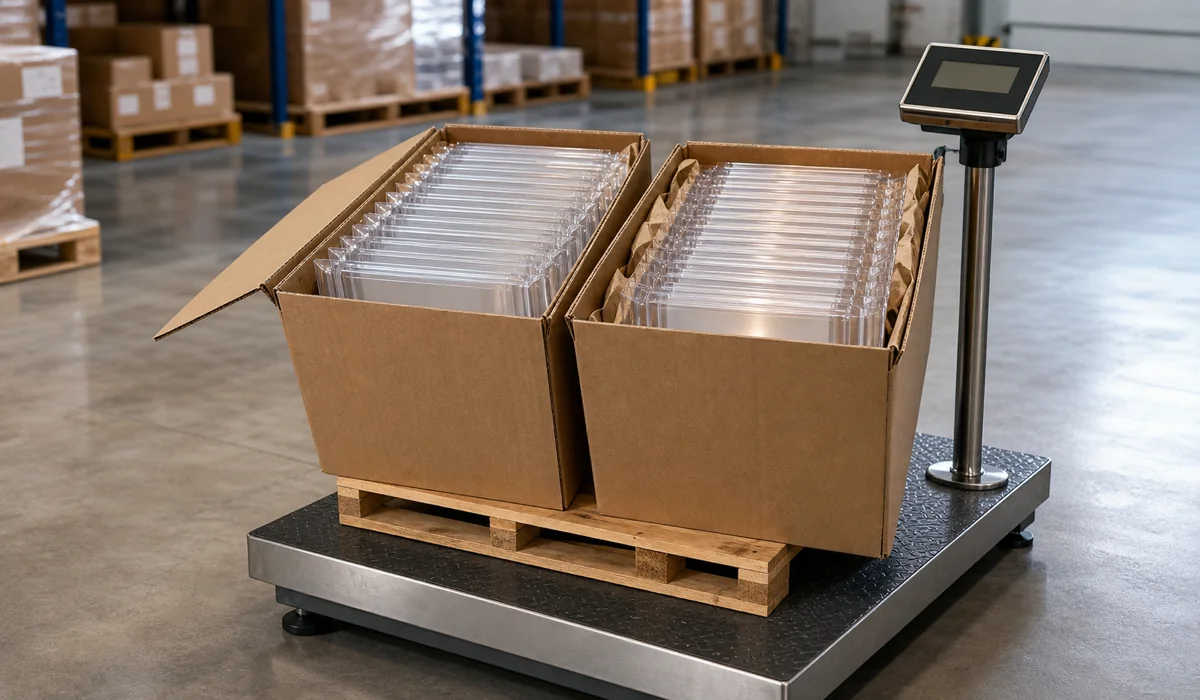
Multiply across a 200-frame order of 16×20s and the glazing alone weighs 149 kg in acrylic against 306 kg in glass, before frames, backing, and packaging enter the carton. Sea freight prices partly by weight and partly by volume, but air freight (the mode event and hospitality programs reach for when deadlines compress) prices by chargeable weight directly. Halving panel weight is not a rounding error there. Packed-carton dimensions and gross weights are supplied with our quotes as standard, so your forwarder can price the lane before you commit.
Weight also follows the frame after delivery. Lighter frames mean lighter loads on your walls, simpler mounting hardware, and less strain on any adhesive system you specify. The hotel merchandising teams we supply rearrange frames constantly; when I pack inspection samples for a program like that, the weight difference between an acrylic set and the glass frames they're replacing is obvious before the carton is sealed.
Glazing weight decides freight cost at volume. An acrylic panel weighs a little under half its glass equivalent; across 200 frames, that is a triple-digit kilogram difference on the scale.
---
## Shatter risk — retail floors, hospitality, and shipping lanes {#shatter-risk}
Acrylic does not shatter. Drop it, ship it badly, let a guest knock it off a hotel dresser: the panel may scratch or crack under extreme abuse, but it does not explode into fragments. Glass does. For any frame that ships in bulk, hangs where people move, or sits within reach of children, that single property changes the risk category.
We deliberately keep this section qualitative. I won't quote a transit-breakage percentage, because we don't have a verified number for glass. We don't ship glass. What I can say from the buyer side of 1,000+ inspected orders is that glass breakage in transit is a known, budgeted program cost for the resellers who come to us: they carry replacement stock, they file carrier claims, they eat the customer-service time. If you've resold glass-glazed frames, that line already sits in your budget. Shatter-resistant acrylic doesn't reduce it. It removes the category. When a frame program has no glass in it, "arrived broken" claims on glazing effectively stop being a planning input.
The same logic applies after installation. Hospitality chains and retail programs choose acrylic glazing for guest rooms, lobbies, and sales floors for the same reason building codes push safety glazing near doors: when the material fails, it fails without producing shards. A cracked acrylic panel is a replacement order. A shattered glass panel in a guest corridor is an incident report.
---
## Optical clarity and UV — transmission and fade protection {#clarity-uv}
On clarity, the two materials tie for practical purposes: clear cast acrylic transmits up to 92% of visible light[^plexiglas-transmission], effectively indistinguishable from framing glass in front of a print. Where they separate is ultraviolet behavior. Standard acrylic already outperforms regular glass on UV, and UV-filtering acrylic grades absorb the bulk of UV wavelengths: the spec class we quote for archival-grade framing of prints, certificates, and photographs. The exact absorption figure varies by grade and wavelength band, so ask for the specific grade's datasheet with the quote; we attach it whenever a program specs UV-filtering sheet.
That UV performance matters because light exposure is the primary enemy of displayed photographs. The Library of Congress's preservation guidance for photographs puts "limit light exposure" at the top of its display recommendations, precisely because cumulative light causes the fading and yellowing that ends a print's display life[^loc-photo]. If your frames will hold fade-sensitive content — limited-edition prints, archival photos, certificates that must stay legible for decades — UV-filtering acrylic is the stronger glazing, and you can spec it per order rather than buying into a premium product line.
A terminology note, because buyers arrive with three names for one material: a plexiglass picture frame, a perspex frame, and an acrylic frame are all PMMA. Plexiglas and Perspex are historical trade names that became generic. When you compare quotes across suppliers, confirm the quote specifies cast acrylic. Cast sheet holds clarity and machines cleaner than cheaper extruded sheet, which is where most of acrylic's bad reputation for yellowing was earned. We fabricate frames from cast sheet only, and our incoming-material inspection checks the sheet certificate against the order spec before a single panel is cut.
---
## Scratch resistance — where glass honestly wins {#where-glass-wins}
Glass has the harder surface, and this comparison won't hide it. A glass-glazed frame shrugs off the daily micro-abrasion of dusting cloths, rings, and keys; acrylic will pick up fine scratches under the same treatment. For high-touch tabletop frames in a busy retail environment where staff wipe them down hourly, glass earns real consideration on this axis.
The reason we still glaze those programs in acrylic is that the exposure is manageable while glass's failure modes are not. Three mitigations do most of the work. First, factory protective film: every panel leaves our line with film applied, and for reseller programs we recommend it stays on until the end customer unwraps the frame, so the panel arrives untouched no matter how many hands the carton passes through. Second, edge quality: a diamond-polished edge resists the chip-and-snag damage that, in my inspection experience, starts most visible frame wear. Third, care instructions on the install sheet printed for your SKUs: microfiber and water, never dry paper towels, which grind dust across the surface.
And when a scratch does happen, acrylic offers something glass cannot: shallow scratches polish out. A scratched glass panel is a replacement; a lightly scratched acrylic panel is often a two-minute buffing.
---
## Flatness and warp on large panels — the spec conversation {#flatness-warp}
Large flat frames raise a question glass buyers never think to ask: will the panel stay flat? Glass holds dead flat at any framing size. Acrylic is a thermoplastic: it moves slightly with temperature and humidity, and on a large thin panel that movement reads as bow or ripple in raking light.
Buyers who have been burned before sometimes arrive with a written tolerance, and the most common version is some form of "no more than 1 mm of deviation per 500 mm" across a 24×36 inch panel. Here is what we tell them: at 3 mm thickness, that is not an achievable spec for acrylic. Not from us, not from anyone, no matter what a quote promises. A supplier who signs that line at 3 mm is planning to argue about measurement method later, not to hold the number.
The real fix is a thickness step. Stiffness rises steeply with thickness, so the working answer for large-format flatness is 5 mm where 3 mm was quoted, or 8 mm for panels at the 24×36 inch end, paired with mounting that supports the panel at multiple points rather than letting it hang free. Stepping up costs material and freight weight (the table in the weight section prices exactly that trade), but it is the difference between a panel that reads flat on a gallery wall and one that catches every ceiling light in a wave. When a program's budget can't absorb the thicker panel, we say so at quote time and re-spec the size or the mounting instead, because a flatness complaint after delivery has no good resolution.
---
## Edge finish — what a sample actually tells you {#edge-finish}
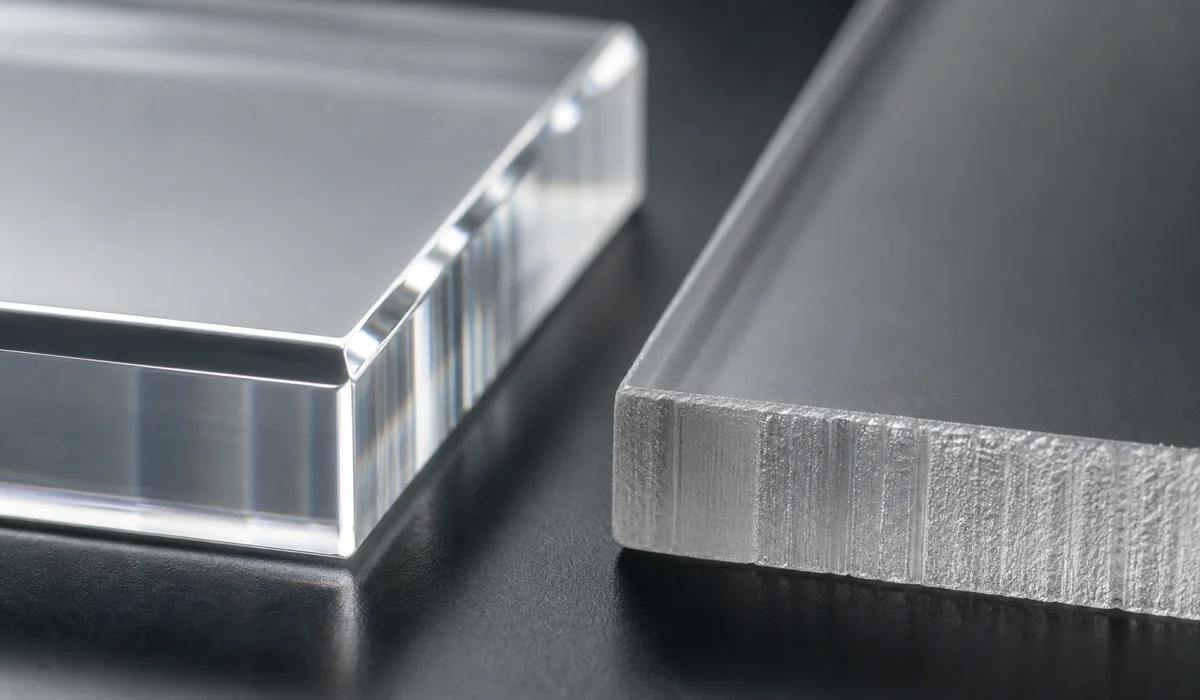
The fingertip test tells you most of what a frame sample can say. Run a fingertip along every edge: a diamond-polished edge feels like glass — flat, cool, no ripple — and looks optically clear when sighted down its length. A flame-polished edge is glossy but can carry a slight thermal undulation that reads as waviness under the finger. A raw saw or laser cut feels matte and toothy. All three have legitimate uses at different price points; the failure is when a supplier quotes "polished edges" and ships the cheaper route.
Edge finish is where frame quality is actually decided, and it's the check a sample lets you run before committing to a bulk order. When my inspection team opens a finished order for final QC, the edges get checked before the faces. A reseller comparing supplier samples asked us last year how to tell a good edge from a bad one across the three quotes on his desk; the fingertip test above was the answer, and our [diamond vs flame polishing guide](/guide/diamond-vs-flame-polishing-acrylic/) covers how each process works and what each costs.
The protection is contractual, not visual: get the edge finish named in the quote and written into the sample acceptance criteria. "Diamond-polished edges, no saw marks, no thermal ripple" is inspectable language; "polished" alone is not. This is also why we push physical samples over renders for frame programs. A render cannot show an edge, which is exactly the argument in our [physical sample vs 3D render guide](/guide/physical-acrylic-sample-vs-3d-render/). We ship samples in 3–5 days, and the sample's edge becomes the standard the production run gets inspected against: piece by piece, 100% of the order, on my line.
The fingertip test made visible: diamond-polished edge (left) against a raw machine cut. The edge is the first thing our QC line checks and the first thing your sample can prove.
---
## Lifecycle cost for resellers — replacement, returns, and program math {#lifecycle-cost}
Sheet price favors glass; program price usually favors acrylic. Compare the two glazings on material cost alone and standard framing glass often comes in slightly cheaper per panel. That comparison flatters glass because it stops at the loading dock. Your real cost per frame includes freight weight, transit loss, return handling, and replacement logistics across the frame's service life, and each of those lines moves in acrylic's favor.
Walk the lifecycle. Inbound: acrylic's lower weight cuts your freight, and its shatter resistance means transit damage is an exception rather than a budgeted allowance. Selling period: no glass shards means no liability conversation for frames sold into hospitality, schools, or family retail. Service life: wall-mounted acrylic frames in low-touch positions run for years without intervention, and light surface wear can be polished rather than replaced. End of line: when a panel does need replacing, shipping a single acrylic panel to a customer is cheap and survivable; shipping a single glass panel is neither.
The gallery programs we supply are a working example. The [colored floating frames we built for art galleries](/case-studies/colored-acrylic-floating-frames-art-galleries/) hang in exactly the environment where glazing failure is most expensive: public space, valuable content, frequent rehangs. Galleries went to acrylic glazing years before hospitality did, for lifecycle reasons rather than unit price.
Reorders close the loop. Because we keep the cutting programs, polish specs, and edge acceptance criteria on file for every frame order, a replacement or expansion run reproduces the original batch rather than approximating it. In final QC we check reorder panels against the retained golden sample from the first production run; the frame a hotel adds in year three should be indistinguishable from the frame it hung in year one. That batch-to-batch consistency is itself a lifecycle cost line: programs that can't re-buy matching frames end up replacing whole walls.
---
## Decision matrix — which glazing for which frame program {#decision-matrix}
No single winner exists across every program, so here is the matrix we walk buyers through. Find your program type in the left column, and the glazing recommendation follows from which failure mode costs you more: scratches (favors glass) or weight, breakage, and UV fade (favor acrylic).
| Frame program | Dominant risk | Recommended glazing |
|---|---|---|
| Hospitality guest rooms & corridors | Impact, guest safety, rehang weight | Acrylic |
| Shipped e-commerce / drop-ship frames | Transit breakage, freight cost | Acrylic |
| Gallery & archival display | UV fade, handling weight | UV-filtering acrylic |
| Corporate awards & certificate walls | UV fade on documents, install weight | UV-filtering acrylic |
| High-touch retail tabletop frames | Daily surface abrasion | Glass — or filmed acrylic with polished-edge criteria |
| Children's / education spaces | Shatter injury | Acrylic, no exception |
Two of those six rows genuinely argue for glass, and when a buyer's program lives in them, we say so and quote accordingly; a program specced wrong on day one costs both sides more than a lost order ever would. For the other four, the acrylic vs glass frame question is mostly settled by logistics before aesthetics enter the room. Every acrylic program we quote starts at a 50-piece MOQ with 3–5 day samples, 15–20 day production, standard 30% deposit / 70% before shipment terms, and the edge-finish acceptance criteria from this guide written into the quote.
Weighing glazing for a specific frame spec — size, thickness, mounting, print content? [Send us the details](/contact/?source=acrylic-vs-glass-picture-frame) and we'll return a glazing recommendation with the weight math run for your actual order quantity, within 24 hours.
[^makeitfrom-pmma]: [PMMA (acrylic) density ~1.2 g/cm³ — MakeItFrom material data](https://www.makeitfrom.com/material-properties/Polymethylmethacrylate-PMMA-Acrylic) — independent materials database displaying the PMMA density value used in this guide's panel-weight and freight calculations.
[^imetra-glass]: [Soda-lime glass density 2.47 g/cm³ — Imetra material properties](https://www.imetra.com/soda-lime-glass-material-properties/) — engineering reference showing the soda-lime glass density that anchors the acrylic-to-glass weight ratio at roughly 2:1.
[^plexiglas-transmission]: [Light transmission — PLEXIGLAS (Röhm)](https://www.plexiglas.de/en/service/product-info/light-transmission) — manufacturer data showing clear-transparent PMMA transmits up to 92 percent of light in the visible range, the clarity figure this guide uses for the transmission tie between acrylic and framing glass.
[^loc-photo]: [Library of Congress — Care, Handling, and Storage of Photographs](https://www.loc.gov/preservation/care/photo.html) — national preservation guidance recommending limited light exposure for displayed photographs, supporting the fade-protection case for UV-filtering glazing.