---
title: "Acrylic vs Glass for Displays: A Manufacturer's Honest Take"
description: "Plexiglass vs glass for displays — weight, clarity, break resistance, and cost compared by a factory engineer who ships both. Spec the right material first."
category: "Comparison"
author: "Dillion Chen"
authorCredential: "Production Manager at Wetop Acrylic — running laser, CNC, polishing, and UV printing lines since 2014, 1,500+ custom projects personally overseen"
datePublished: 2026-03-06
dateModified: 2026-03-06
primaryKeyword: "plexiglass vs glass"
url: https://wetopacrylic.com/guide/acrylic-vs-glass-displays/
---
## Why Most Display Buyers Switch to Acrylic {#switch-to-acrylic}
In the plexiglass vs glass debate for retail displays, plexiglass wins on four of the five dimensions that actually matter in commercial display use: weight, impact resistance, workability, and shipping survivability. Acrylic — the technical name for plexiglass — outperforms glass for countertop stands, display cases, and custom retail fixtures in nearly every practical measure. The one area where glass holds a real advantage is scratch hardness — and for most display applications, that single tradeoff still favors acrylic.
I see this decision come up on nearly every inquiry that involves a display case or retail fixture. Buyers who've worked with glass suppliers often assume glass is the premium material and plexiglass is the budget substitute. That framing is wrong for most display applications. Glass is heavier, more fragile in transit, harder to fabricate custom shapes from, and — counterintuitively — not actually clearer than quality cast acrylic. The buyers who understand the plexiglass vs glass tradeoffs upfront get a better product at lower total cost. The ones who don't sometimes discover it after receiving 20 shattered glass panels from their freight carrier.
---
## How Acrylic and Glass Compare on the 5 Specs That Matter {#comparison}
Acrylic and glass differ across five properties that actually drive display project decisions: optical clarity, weight, impact resistance, workability, and scratch resistance. The table below uses real material data — not marketing claims.
For display applications specifically, optical clarity and weight are usually the deciding factors, with impact resistance becoming critical as soon as the product ships by sea freight. Workability matters when your design involves curves, complex cuts, or custom shapes — glass fabrication is slow and expensive compared to laser or CNC acrylic work. Scratch resistance is the one dimension where glass has an unambiguous advantage, and we'll cover it honestly in the next section.
### Plexiglass vs glass: material property comparison
| Property | Acrylic (Cast PMMA) | Standard Float Glass | Winner |
|---|---|---|---|
| Light transmittance | 90–92% (ASTM D1003) | 88–90% | Acrylic (slight edge) |
| Density | ~1.19 g/cm³ | ~2.5 g/cm³ | Acrylic (2.1× lighter) |
| Impact resistance vs glass | 10–17× more resistant | Baseline | Acrylic |
| Scratch hardness (Mohs) | 2–3 | ~6 | Glass |
| Custom fabrication | Laser, CNC, thermoform | Cut and grind only | Acrylic |
| UV stability (standard grade) | Yellows without UV treatment | Stable | Glass |
| UV stability (UV-stabilized grade) | Stable 10+ years outdoor | Stable | Tie |
| Failure mode | Large dull-edged pieces | Sharp shards | Acrylic (safer) |
| Weight per m² at 5mm | ~6 kg | ~12.5 kg | Acrylic |
The transmittance figures for cast acrylic are documented by major PMMA manufacturers, including Plaskolite[^plaskolite] and Evonik PLEXIGLAS[^plexiglas], and measured against the ASTM D1003 haze and luminous transmittance standard[^astm-d1003] — the industry method for comparing clarity across transparent plastics.
Five independent comparisons. Acrylic wins on optical clarity (slightly), weight, impact, and fabrication flexibility. Glass wins decisively on scratch hardness - which is why public-touch surfaces often go to tempered glass.
---
## Where Glass Still Wins {#where-glass-wins}
Glass is the correct material for high-heat environments, applications with aggressive daily cleaning, and permanent architectural installations where scratch accumulation over years is unacceptable. For these use cases, we recommend glass — and I'll say so directly on a quote rather than ship the wrong material.
The three scenarios where glass genuinely outperforms acrylic for display applications: first, displays positioned directly under high-output retail spot lighting (surface temperatures above 65°C / 150°F) — acrylic softens at around 80–100°C, and sustained heat from powerful fixtures accelerates distortion over time. Second, museum and archival displays where glass is cleaned daily with professional-grade solvents — acrylic crazes under acetone and some industrial cleaners. Third, permanent in-store installations that won't be refreshed for 5–10 years, where accumulated surface scratches on acrylic would degrade the display appearance in ways a glass panel would not.
For everything else — custom display cases, countertop stands, retail fixtures, POP displays, exhibition booths, [trading card displays](/guide/trading-card-display-case-guide/), and anything that ships by freight — acrylic is the stronger material choice on the dimensions buyers actually care about.
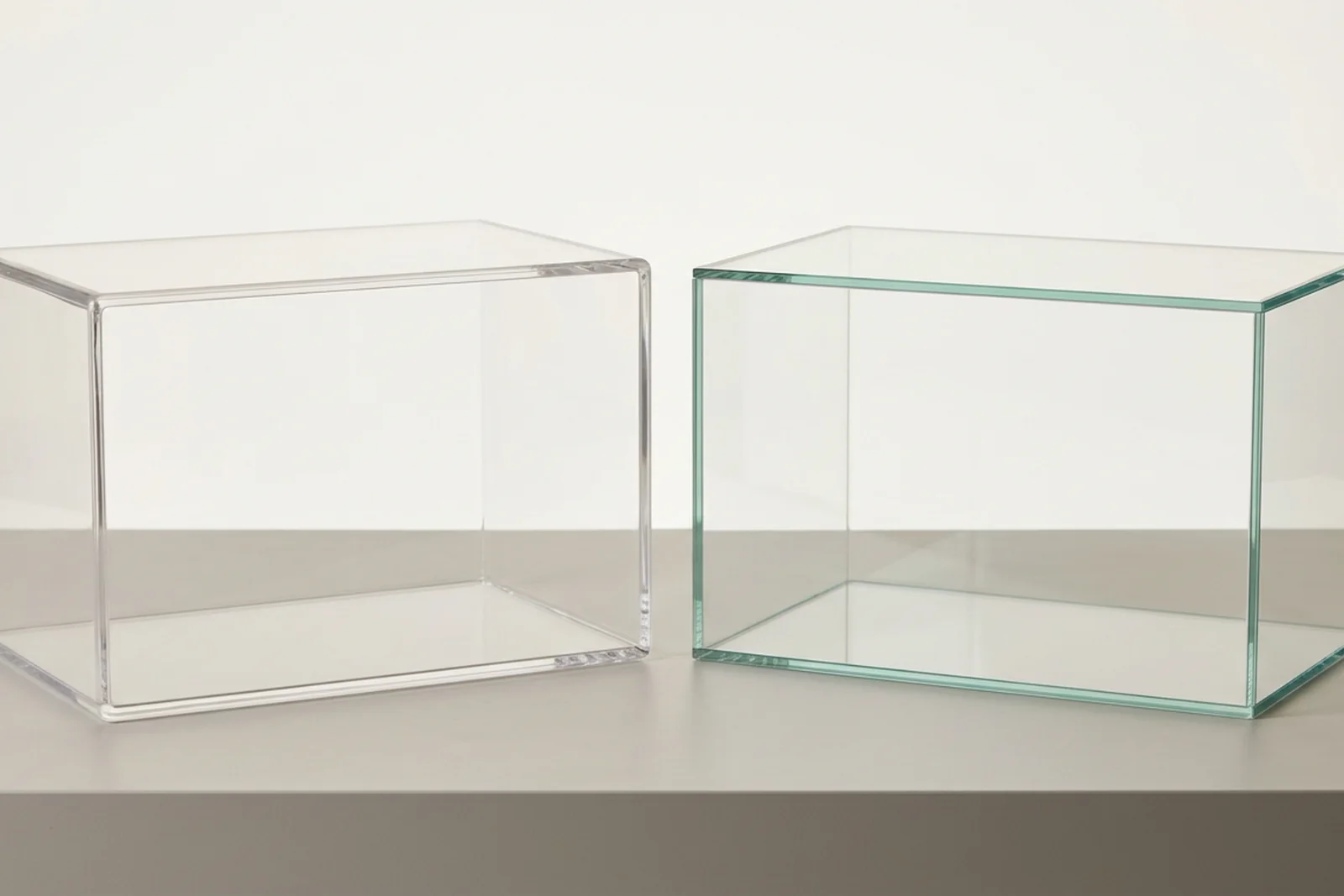
Same dimensions, same light. The optical difference is 2 percentage points of transmittance - invisible to most shoppers. The practical differences (weight, impact, fabrication cost) never make it into the photo.
---
## Weight, Safety, and Breakage: The Practical Gap {#safety-weight}
The weight difference between acrylic and glass is not academic — it has direct, measurable consequences for shipping cost, display installation, and product safety. A 5mm acrylic panel weighs approximately 6 kg per square meter; the equivalent glass panel weighs approximately 12.5 kg. For a display case with four panels totaling 1 m² of material, that's 6.5 kg of weight savings per unit before you add the base and hardware.
We ship acrylic display cases to US and European buyers by sea freight — 30-day ocean transit on container ships that stack 10 containers high, driven by forklifts, and handled by dock workers who are not thinking about your custom display cases. Glass panels require substantially heavier crating, more internal padding, corner protection, and fragile-route routing — all of which add cost and still don't guarantee arrival intact. In 12+ years of shipping displays from our Shenzhen factory, I've never had a well-packed acrylic case arrive broken in transit. Glass is a different story — even with premium crating, we used to see 3–8% breakage rates on glass panels shipped by sea. That's not a cost of doing business — that's a cost of the wrong material choice.
The safety dimension matters for public-facing retail displays. When an acrylic panel fails under impact — from a fall, an accidental strike, or a customer interaction — it fractures into large, dull-edged pieces. Standard glass fractures into sharp shards; even tempered safety glass, which the Plastics Industry Association[^plastics-industry] notes is engineered to reduce lacerations, produces small fragments rather than large pieces. For child-adjacent retail, trade show environments, or any display people walk close to, acrylic's failure mode is meaningfully safer.
Characteristic failure mode under equivalent impact load. Acrylic breaks in low-count, rounded fragments; glass shatters into many sharp shards — a meaningful safety difference in customer-facing retail environments.
---
## Optical Clarity: Closer Than You Think {#optical-clarity}
The assumption that glass is optically superior to acrylic is one of the most persistent misconceptions in display material selection — and it's usually based on comparing low-grade extruded acrylic against high-quality float glass. Cast acrylic, which is what we use in all Wetop display cases and stands, transmits 90–92% of visible light. Standard float glass transmits 88–90%. The measured difference, per ASTM D1003, is essentially zero for human perception in a display context.
Where acrylic can look inferior is when buyers specify extruded acrylic instead of cast. Extruded acrylic is cheaper and more dimensionally consistent, but its lower molecular weight causes microscopic internal stress lines that scatter light and create a faint haze — particularly visible on thick pieces. Above 6mm, we always specify cast acrylic for displays where optical quality matters. The haze value (measured as the percentage of scattered light) for quality cast acrylic runs below 1%, which matches or beats float glass in side-by-side comparison. If you've ever seen acrylic that looked milky or slightly yellow next to glass, that's a material grade issue — not an inherent property of PMMA.
The one optical area where glass holds a practical edge: anti-reflective coatings. Museum glass with multi-layer AR coatings achieves near-zero surface reflection, which acrylic AR coatings approximate but don't quite match for the most demanding archival display applications. For standard retail and commercial displays, this difference is invisible to end customers.
---
## Cost Comparison: What Buyers Actually Pay {#cost}
In the plexiglass vs glass cost comparison, acrylic wins at the raw material level and then widens the gap at fabrication. Acrylic display cases and panels typically cost 20–40% less in raw material than glass equivalents at the same size and quality, and fabrication savings widen that gap further when designs involve curves, cutouts, or complex assemblies. Glass cutting and grinding is slow and specialized; acrylic laser cutting and CNC routing is fast and precise. Every hour of labor saved in fabrication is a dollar saved on your landed cost.
I walk buyers through four variables that determine the total cost difference on any specific project. First, the raw material cost gap: cast acrylic sheet runs roughly 30–50% less per square meter than equivalent-quality float glass in comparable thicknesses. Second, fabrication speed: a laser cutter moves through 5mm acrylic at a speed and precision that glass cutting equipment cannot match — custom shapes, rounded corners, and complex cutouts that would take a glass shop two days we can do in hours. Third, shipping cost: lighter panels mean lower freight weight, which compounds across container loads. On a 500-unit production run of display cases, the freight savings from acrylic versus glass can offset a meaningful portion of unit cost. Fourth, breakage replacement cost: glass displays need replacement panels; acrylic panels that scratch can sometimes be polished and reused, and the ones that fracture ship as reliably packaged replacements without the fragile routing cost.
For an exact cost comparison on your specific display design, send specs to inquiry@wetopacrylic.com — we'll quote both materials if your application genuinely calls for comparison, and we'll tell you directly which we recommend. We respond within 24 hours.
---
## Which to Specify for Your Display Project {#which-to-specify}
For the vast majority of custom B2B display applications, specify acrylic — specifically cast PMMA at the appropriate thickness for your load and span requirements. The decision tree below covers the common cases where glass might still be the right call.
Your project should use **glass** if: the display will be permanently mounted in a high-traffic retail environment for 5+ years with daily professional cleaning, OR it will be exposed to sustained surface temperatures above 65°C from spotlight fixtures, OR it's a museum-quality archival application requiring the absolute best anti-reflective coating performance.
Your project should use **acrylic** if: the display ships by freight (acrylic survives; glass often doesn't), OR your design has non-rectangular shapes (glass can't be thermoformed), OR you need fast lead times (acrylic fabrication is faster at every step), OR the display is accessible to the public (acrylic's failure mode is safer), OR budget matters and both materials meet your clarity requirement (acrylic is typically 20–40% less expensive before shipping savings).
For custom display cases, countertop stands, acrylic risers, and retail display fixtures, we fabricate in cast acrylic as the default — 3mm to 20mm depending on the application. Cosmetic brands and luxury beauty merchandising are among the clearest beneficiaries of the switch: the weight savings and impact resistance matter when floor sets are installed and refreshed seasonally — see our guide on [cosmetic merchandising with acrylic displays](/guide/cosmetics-acrylic-display-benefits/) for how those tradeoffs play out in practice. If your design brief specifies glass and you want a second opinion on whether acrylic is viable, include that question when you send your RFQ. I review every quote personally and will give you a direct answer, not a sales pitch.
For thickness selection within acrylic — which is often the follow-on question after material selection — see our [acrylic thickness guide](/guide/acrylic-thickness-guide/) covering load, span, and cost tradeoffs from 1.5mm to 25mm. For the product categories where acrylic vs glass comparisons come up most often, see our [acrylic display cases](/products/acrylic-cases/) and [acrylic display stands](/products/acrylic-displays/) pages, and for industry context, our [point-of-purchase display](/applications/pop-pos-displays/) use cases show where break resistance and transit durability tip the decision toward acrylic.
[^astm-d1003]: [ASTM D1003-21 — Haze and Luminous Transmittance of Transparent Plastics](https://store.astm.org/d1003-21.html) — the industry-standard test method for measuring how much light passes through a transparent material. Clarity comparisons between acrylic and glass reference this standard for comparable, verifiable data.
[^plaskolite]: [Plaskolite — Cast and Extruded Acrylic Technical Resources](https://www.plaskolite.com/) — US-based PMMA sheet manufacturer; publishes optical property data and thickness tolerances for cast and extruded acrylic grades used in display fabrication.
[^plexiglas]: [Evonik PLEXIGLAS — Acrylic Sheet Products](https://www.plexiglas.com/) — manufacturer of PLEXIGLAS-brand cast and extruded PMMA; publishes transmittance, haze, and UV stability data for standard and UV-stabilized grades used in outdoor display and signage applications.
[^plastics-industry]: [Plastics Industry Association](https://www.plasticsindustry.org/) — US trade association for the plastics industry; publishes material performance data and safety comparisons for plastic glazing alternatives to glass in commercial and retail applications.