---
title: "How to Choose Acrylic Thickness: Manufacturer's Guide"
description: "Choose the right acrylic thickness for your project. Manufacturer's chart covering 1.5mm to 25mm with load, span, cost, and fabrication tradeoffs."
category: "Buyer Guide"
author: "Dillion Chen"
authorCredential: "Production Manager at Wetop Acrylic — running laser, CNC, polishing, and UV printing lines since 2014, 1,500+ custom projects personally overseen"
datePublished: 2026-02-24
dateModified: 2026-02-24
primaryKeyword: "acrylic thickness"
url: https://wetopacrylic.com/guide/acrylic-thickness-guide/
---
## Start With These 4 Variables {#framework}

Acrylic thickness should be chosen by working through four variables in order: load (what it holds), unsupported span (how far it spans between supports), edge exposure (whether edges are visible), and visual weight (how solid it needs to look). Start with the first variable that sets a minimum — the remaining three either confirm it or push you thicker.

In my experience, most buyers approach thickness the wrong way. They pick a number from a reference photo, ask for "something sturdy," or default to whatever thickness they saw on a competitor's product. That works until it doesn't — usually in month two of use, when the customer calls: a shelf that was supposed to hold six tablets is bowing like a hammock, or a box lid has cracked near a hinge point. The four-variable framework replaces guesswork with a repeatable decision. Load sets the minimum strength. Span amplifies deflection at any given thickness. Edge exposure determines whether you need a thickness that polishes cleanly. Visual weight is last because it's a design preference, not a structural one.

### The four variables, ranked

| Variable | What It Controls | Typical Outcome |
|----------|-----------------|-----------------|
| Load | Minimum thickness for the weight carried | Sets the floor |
| Unsupported span | How thick to prevent sag between supports | Often pushes thicker than load alone |
| Edge exposure | Thickness that polishes cleanly (flame or diamond) | 5mm+ for polished visible edges |
| Visual weight | Premium "solid" feel | Pushes to 8-10mm for awards, luxury display |

Work top to bottom. If load says 3mm and span says 8mm, pick 8mm.

<figure class="guide-diagram">
  <svg viewBox="0 0 1200 600" xmlns="http://www.w3.org/2000/svg" role="img" aria-label="Acrylic thickness decision flowchart: four variables — Load, Unsupported Span, Edge Exposure, Visual Weight — each setting a minimum thickness. Pick the maximum across all four.">
    <title>Acrylic thickness decision flowchart — 4 variables</title>
    <desc>Four-card decision flow for picking acrylic sheet thickness. Each variable (Load, Unsupported Span, Edge Exposure, Visual Weight) sets its own minimum thickness recommendation in millimeters. Final spec is the maximum across all four cards, not an average.</desc>
    <rect width="1200" height="600" fill="#f5f5f7" rx="12"/>
    <text x="600" y="48" text-anchor="middle" font-family="Inter,sans-serif" font-size="20" font-weight="600" fill="#1d1d1f">Decision Flow — Each Variable Sets a Minimum</text>
    <text x="600" y="74" text-anchor="middle" font-family="Inter,sans-serif" font-size="13" fill="#86868b">Work top to bottom. Final thickness = MAX of all four minimums.</text>
    <!-- 4 cards -->
    <!-- Card 1: LOAD -->
    <g>
      <rect x="30" y="110" width="270" height="380" rx="14" fill="#ffffff" stroke="#d2d2d7" stroke-width="1.5"/>
      <circle cx="165" cy="160" r="24" fill="#0071e3" fill-opacity="0.1" stroke="#0071e3" stroke-width="1.5"/>
      <path d="M155 152 L175 152 L172 170 L158 170 Z" fill="#0071e3"/>
      <text x="165" y="210" text-anchor="middle" font-family="Inter,sans-serif" font-size="11" fill="#86868b" letter-spacing="0.8">STEP 1</text>
      <text x="165" y="232" text-anchor="middle" font-family="Inter,sans-serif" font-size="18" font-weight="600" fill="#1d1d1f">LOAD</text>
      <text x="165" y="252" text-anchor="middle" font-family="Inter,sans-serif" font-size="12" fill="#86868b">What will it hold?</text>
      <line x1="55" y1="280" x2="275" y2="280" stroke="#e5e5ea"/>
      <text x="55" y="305" font-family="Inter,sans-serif" font-size="13" fill="#424245">Light / decorative</text>
      <text x="275" y="305" text-anchor="end" font-family="Inter,sans-serif" font-size="13" font-weight="600" fill="#1d1d1f">3mm</text>
      <text x="55" y="335" font-family="Inter,sans-serif" font-size="13" fill="#424245">Medium object</text>
      <text x="275" y="335" text-anchor="end" font-family="Inter,sans-serif" font-size="13" font-weight="600" fill="#1d1d1f">5mm</text>
      <text x="55" y="365" font-family="Inter,sans-serif" font-size="13" fill="#424245">Heavy / weighted</text>
      <text x="275" y="365" text-anchor="end" font-family="Inter,sans-serif" font-size="13" font-weight="600" fill="#1d1d1f">8mm+</text>
      <text x="55" y="395" font-family="Inter,sans-serif" font-size="13" fill="#424245">Structural</text>
      <text x="275" y="395" text-anchor="end" font-family="Inter,sans-serif" font-size="13" font-weight="600" fill="#1d1d1f">12mm+</text>
    </g>
    <!-- Card 2: SPAN -->
    <g>
      <rect x="323" y="110" width="270" height="380" rx="14" fill="#ffffff" stroke="#d2d2d7" stroke-width="1.5"/>
      <circle cx="458" cy="160" r="24" fill="#0071e3" fill-opacity="0.1" stroke="#0071e3" stroke-width="1.5"/>
      <line x1="446" y1="160" x2="470" y2="160" stroke="#0071e3" stroke-width="2"/>
      <polygon points="446,160 452,156 452,164" fill="#0071e3"/>
      <polygon points="470,160 464,156 464,164" fill="#0071e3"/>
      <text x="458" y="210" text-anchor="middle" font-family="Inter,sans-serif" font-size="11" fill="#86868b" letter-spacing="0.8">STEP 2</text>
      <text x="458" y="232" text-anchor="middle" font-family="Inter,sans-serif" font-size="18" font-weight="600" fill="#1d1d1f">UNSUPPORTED SPAN</text>
      <text x="458" y="252" text-anchor="middle" font-family="Inter,sans-serif" font-size="12" fill="#86868b">Distance between supports</text>
      <line x1="348" y1="280" x2="568" y2="280" stroke="#e5e5ea"/>
      <text x="348" y="305" font-family="Inter,sans-serif" font-size="13" fill="#424245">&lt; 200 mm</text>
      <text x="568" y="305" text-anchor="end" font-family="Inter,sans-serif" font-size="13" font-weight="600" fill="#1d1d1f">3mm</text>
      <text x="348" y="335" font-family="Inter,sans-serif" font-size="13" fill="#424245">200 – 400 mm</text>
      <text x="568" y="335" text-anchor="end" font-family="Inter,sans-serif" font-size="13" font-weight="600" fill="#1d1d1f">5mm</text>
      <text x="348" y="365" font-family="Inter,sans-serif" font-size="13" fill="#424245">400 – 800 mm</text>
      <text x="568" y="365" text-anchor="end" font-family="Inter,sans-serif" font-size="13" font-weight="600" fill="#1d1d1f">8mm+</text>
      <text x="348" y="395" font-family="Inter,sans-serif" font-size="13" fill="#424245">&gt; 800 mm</text>
      <text x="568" y="395" text-anchor="end" font-family="Inter,sans-serif" font-size="13" font-weight="600" fill="#1d1d1f">12mm+</text>
    </g>
    <!-- Card 3: EDGE EXPOSURE -->
    <g>
      <rect x="616" y="110" width="270" height="380" rx="14" fill="#ffffff" stroke="#d2d2d7" stroke-width="1.5"/>
      <circle cx="751" cy="160" r="24" fill="#0071e3" fill-opacity="0.1" stroke="#0071e3" stroke-width="1.5"/>
      <rect x="739" y="152" width="24" height="16" rx="1.5" fill="none" stroke="#0071e3" stroke-width="2"/>
      <text x="751" y="210" text-anchor="middle" font-family="Inter,sans-serif" font-size="11" fill="#86868b" letter-spacing="0.8">STEP 3</text>
      <text x="751" y="232" text-anchor="middle" font-family="Inter,sans-serif" font-size="18" font-weight="600" fill="#1d1d1f">EDGE EXPOSURE</text>
      <text x="751" y="252" text-anchor="middle" font-family="Inter,sans-serif" font-size="12" fill="#86868b">How visible is the edge?</text>
      <line x1="641" y1="280" x2="861" y2="280" stroke="#e5e5ea"/>
      <text x="641" y="305" font-family="Inter,sans-serif" font-size="13" fill="#424245">Hidden in fixture</text>
      <text x="861" y="305" text-anchor="end" font-family="Inter,sans-serif" font-size="13" font-weight="600" fill="#1d1d1f">3mm</text>
      <text x="641" y="335" font-family="Inter,sans-serif" font-size="13" fill="#424245">Side-visible</text>
      <text x="861" y="335" text-anchor="end" font-family="Inter,sans-serif" font-size="13" font-weight="600" fill="#1d1d1f">5mm</text>
      <text x="641" y="365" font-family="Inter,sans-serif" font-size="13" fill="#424245">Feature edge</text>
      <text x="861" y="365" text-anchor="end" font-family="Inter,sans-serif" font-size="13" font-weight="600" fill="#1d1d1f">8mm</text>
      <text x="641" y="395" font-family="Inter,sans-serif" font-size="13" fill="#424245">Glass-like block</text>
      <text x="861" y="395" text-anchor="end" font-family="Inter,sans-serif" font-size="13" font-weight="600" fill="#1d1d1f">15mm+</text>
    </g>
    <!-- Card 4: VISUAL WEIGHT -->
    <g>
      <rect x="909" y="110" width="270" height="380" rx="14" fill="#ffffff" stroke="#d2d2d7" stroke-width="1.5"/>
      <circle cx="1044" cy="160" r="24" fill="#0071e3" fill-opacity="0.1" stroke="#0071e3" stroke-width="1.5"/>
      <rect x="1034" y="150" width="3" height="20" fill="#0071e3"/>
      <rect x="1042" y="154" width="4" height="16" fill="#0071e3"/>
      <rect x="1051" y="148" width="5" height="22" fill="#0071e3"/>
      <text x="1044" y="210" text-anchor="middle" font-family="Inter,sans-serif" font-size="11" fill="#86868b" letter-spacing="0.8">STEP 4</text>
      <text x="1044" y="232" text-anchor="middle" font-family="Inter,sans-serif" font-size="18" font-weight="600" fill="#1d1d1f">VISUAL WEIGHT</text>
      <text x="1044" y="252" text-anchor="middle" font-family="Inter,sans-serif" font-size="12" fill="#86868b">Aesthetic adjustment</text>
      <line x1="934" y1="280" x2="1154" y2="280" stroke="#e5e5ea"/>
      <text x="934" y="305" font-family="Inter,sans-serif" font-size="13" fill="#424245">Wants lightness</text>
      <text x="1154" y="305" text-anchor="end" font-family="Inter,sans-serif" font-size="13" font-weight="600" fill="#1d1d1f">−1 step</text>
      <text x="934" y="335" font-family="Inter,sans-serif" font-size="13" fill="#424245">Neutral</text>
      <text x="1154" y="335" text-anchor="end" font-family="Inter,sans-serif" font-size="13" font-weight="600" fill="#1d1d1f">keep</text>
      <text x="934" y="365" font-family="Inter,sans-serif" font-size="13" fill="#424245">Wants premium feel</text>
      <text x="1154" y="365" text-anchor="end" font-family="Inter,sans-serif" font-size="13" font-weight="600" fill="#1d1d1f">+1 step</text>
      <text x="934" y="395" font-family="Inter,sans-serif" font-size="13" fill="#424245">Luxury / showcase</text>
      <text x="1154" y="395" text-anchor="end" font-family="Inter,sans-serif" font-size="13" font-weight="600" fill="#1d1d1f">+2 steps</text>
    </g>
    <!-- Arrows between cards -->
    <path d="M300 300 L323 300" stroke="#86868b" stroke-width="1.5" fill="none"/>
    <polygon points="323,300 317,296 317,304" fill="#86868b"/>
    <path d="M593 300 L616 300" stroke="#86868b" stroke-width="1.5" fill="none"/>
    <polygon points="616,300 610,296 610,304" fill="#86868b"/>
    <path d="M886 300 L909 300" stroke="#86868b" stroke-width="1.5" fill="none"/>
    <polygon points="909,300 903,296 903,304" fill="#86868b"/>
    <!-- Bottom rule -->
    <rect x="30" y="520" width="1140" height="54" rx="10" fill="#1d1d1f"/>
    <text x="600" y="546" text-anchor="middle" font-family="Inter,sans-serif" font-size="13" fill="#86868b" letter-spacing="0.8">FINAL THICKNESS</text>
    <text x="600" y="568" text-anchor="middle" font-family="Inter,sans-serif" font-size="15" font-weight="500" fill="#ffffff">= MAX (Step 1, Step 2, Step 3) + Step 4 adjustment</text>
  </svg>
  <figcaption>The 4-variable decision flow: work top to bottom, pick the maximum minimum from Steps 1–3, then apply the Step 4 aesthetic adjustment.</figcaption>
</figure>

---

## Standard Acrylic Thickness Options (mm + inch chart) {#chart}

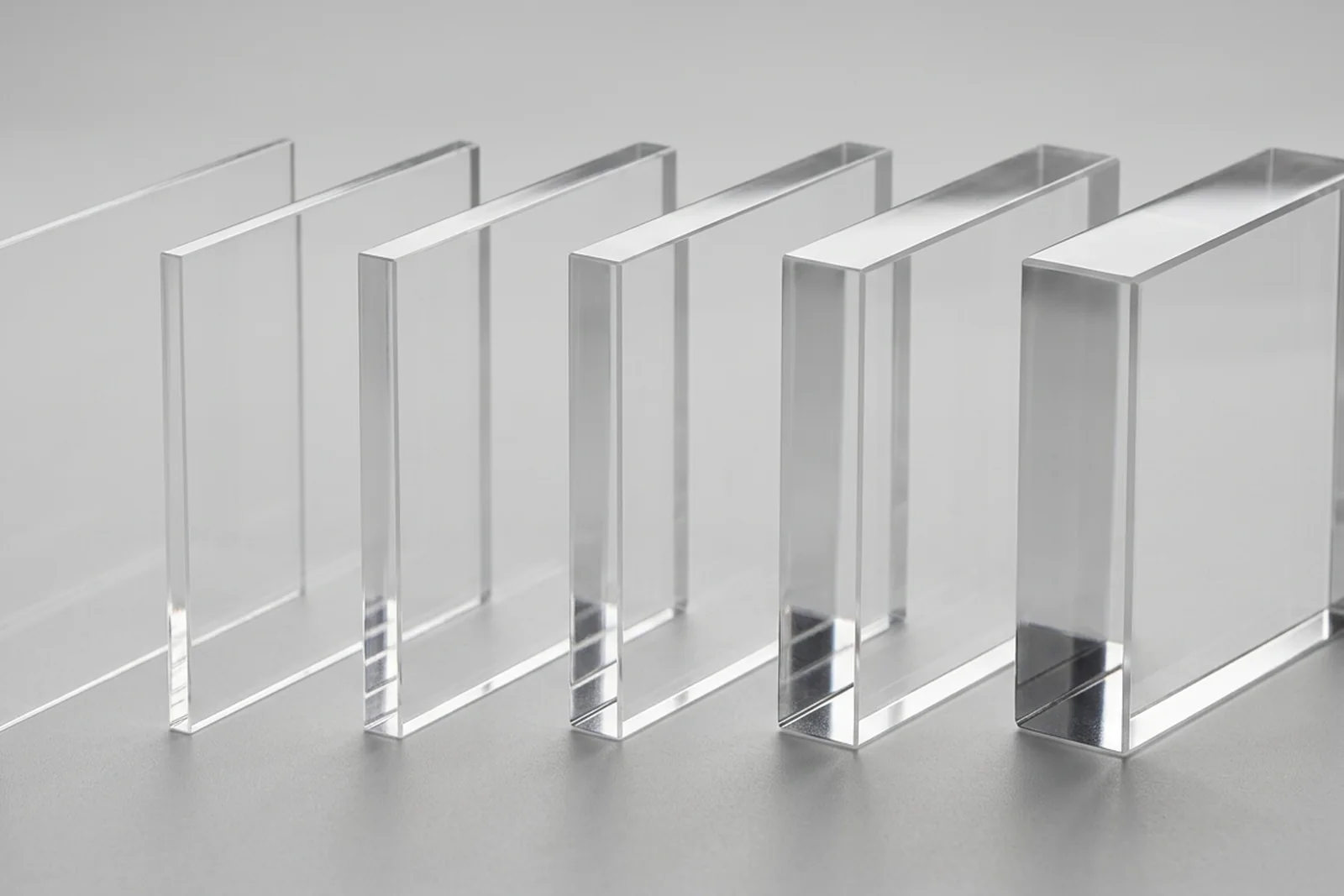
Standard stocked acrylic sheet thicknesses run from 1.5mm (1/16 inch) to 25mm (1 inch) in cast and extruded PMMA, with thicker cast blocks available up to 50mm or more on special order. The chart below is the reference we use for every custom quote — metric, imperial, and what each thickness is typically specified for.

Thickness is where metric and imperial designs collide most often. US buyers send specs in inches; Chinese, European, and most global acrylic stock is sold in millimeters. The values below match commonly stocked sheet gauges — asking for exactly 6.35mm (1/4 inch) when our supply chain stocks 6mm means a custom-ordered sheet, longer lead time, and price premium for no real structural difference. This guide uses the stocked metric sizes as the anchor, with the imperial equivalent every US specifier actually recognizes.

### Acrylic sheet thickness chart

| Metric | Imperial (nearest) | Common Use |
|--------|-------------------|-------------|
| 1.5mm | 1/16" | Signage inserts, light overlays, thin card holders |
| 2mm | — | Sign holder faces, lightweight brochure pockets |
| 3mm | 1/8" | Small boxes, standees, brochure holders, light shelving |
| 4mm | — | Mid-weight signage, photo frame faces |
| 5mm | 3/16" | Countertop displays, mid-size boxes, typical retail risers |
| 6mm | 1/4" | Heavier risers, small display cases, shelf supports |
| 8mm | 5/16" | Display cases, award bases, reinforced shelves |
| 10mm | 3/8" | Large display cases, award blocks, structural supports |
| 12mm | 1/2" | Premium award blocks, trophy bases, heavy-duty cases |
| 15mm | 9/16" | Deep embedment awards, thick trophy layers |
| 20mm | 3/4" | Large block awards, sculptural pieces |
| 25mm | 1" | Heavy trophy bases, luxury product displays |

Stocked material specifications for PMMA sheet — including thickness tolerances and optical properties — are documented by major suppliers such as Plaskolite[^plaskolite]. Sheet thickness tolerances are typically ±5-10% for cast and ±10% for extruded, which is worth noting when your design demands tight fit-up.

<figure class="guide-photo">
  <img src="/images/guides/acrylic-thickness-guide-stacked-samples.webp" alt="Six acrylic (PMMA plexiglass) sample squares stacked on edge from 3mm to 25mm, neutral gray background - thickness progression visible from paper-thin to heavy block." width="1600" height="1067" loading="lazy" decoding="async" />
  <figcaption>Six standard thicknesses in the same cast PMMA stack. The visual jump from 3mm to 8mm is bigger than most buyers expect - and the decision between 8mm and 10mm is almost never about optics, it's about load.</figcaption>
</figure>

---

## Thickness-to-Application Matrix {#matrix}

The fastest way to pick thickness is to match your product category against the matrix below. These are the ranges Wetop uses in active production across 2,000+ custom projects. If your product type is listed, start inside the "typical" range, then adjust up or down using the load/span table in the next section.

This matrix reflects what ships, not what's theoretically possible. A display case can be built from 3mm — it'll just crack on the first drop. Our typical ranges are conservative floors that hold up across 15-20 day production runs and survive international freight. Thicker than the range means you're paying for structural margin you don't need; thinner means you're gambling on transit and handling. For a detailed breakdown of how we plan and QC custom builds, see our [custom acrylic fabrication process overview](/customization/).

### Acrylic thickness by product type

| Product Category | Typical Thickness | Notes |
|------------------|-------------------|-------|
| Small acrylic boxes | 3mm walls, 5mm base | Lightweight gift and retail boxes |
| Display cases (countertop) | 5-8mm walls, 8mm base | Add thicker base for stability |
| Display cases (floor standing) | 8-10mm | 10mm minimum for structural joints |
| Acrylic risers | 3mm (small), 5-8mm (heavy) | Step up for weighted product |
| Countertop display stands | 3-5mm | 5mm default for retail handling |
| Acrylic shelves | 5-10mm | Depends on span; see load table |
| Serving trays | 5-8mm | 5mm minimum for food contact |
| Award plaques | 6-10mm | 8mm reads as "premium" |
| Award blocks / deal toys | 15-50mm | Solid cast block, not sheet |
| Sign holders / card holders | 2-4mm | Tabletop 3mm, wall-mount 4mm |
| Photo frames | 3-5mm | 3mm insert, 5mm magnetic backs |
| Shadow boxes | 5mm face, 8mm frame | Depth drives frame thickness |
| Drawer organizers | 3-5mm | 5mm if loaded with heavy items |

Cross-check against the product page for your category — [acrylic display cases](/products/acrylic-cases/), [acrylic boxes](/products/acrylic-boxes/), [acrylic trays](/products/acrylic-trays/), and [acrylic awards](/products/acrylic-awards/) each list the thicknesses we stock and fabricate most often, with application examples. For [trading card display cases](/guide/trading-card-display-case-guide/), collectors typically specify 5mm walls and an 8–10mm base — the base thickness carries the weight of graded slabs without rocking.

---

## Load and Span: How Thick Is Thick Enough? {#load}

For load-bearing acrylic — shelves, trays, case tops — thickness must be paired with unsupported span. Doubling thickness roughly quadruples bending stiffness; doubling span roughly octuples the sag at the same load. This means span is usually the dominant variable, not load itself, and it's the one I see underestimated most often on buyer drawings. A 3mm sheet is strong enough for 2 kg — but only over a short span.

The numbers below are conservative working guidance derived from standard cast PMMA flexural modulus values (approx. 3,100 MPa)[^matweb] cross-referenced against Wetop's production experience. They assume supports on both ends, evenly distributed load, clear cast acrylic, and room temperature. They are not a substitute for engineering sign-off on safety-critical loads. For heavy retail, hospitality service, or anything overhead, always build in extra margin or add a mid-span support.

### Acrylic shelf/span thickness guidance

| Unsupported Span | Light Load (<2 kg) | Medium Load (2-5 kg) | Heavy Load (5-10 kg) |
|------------------|--------------------|-----------------------|----------------------|
| 150mm / 6" | 3mm | 5mm | 8mm |
| 300mm / 12" | 5mm | 8mm | 10mm |
| 450mm / 18" | 8mm | 10mm | 12mm + support |
| 600mm / 24" | 10mm | 12mm + support | Not recommended — add mid-support |
| 900mm / 36" | Mid-support required at all loads | — | — |

<figure class="guide-diagram">
  <svg viewBox="0 0 1200 600" xmlns="http://www.w3.org/2000/svg" role="img" aria-label="Shelf deflection comparison: a 3mm acrylic shelf sagging visibly under a 2kg load over a 300mm unsupported span, versus an 8mm shelf at the same span and load showing no visible sag.">
    <title>Shelf deflection — 3mm vs 8mm acrylic at 2kg load</title>
    <desc>Structural deflection comparison under the same 2kg load and 300mm unsupported span. The 3mm cast PMMA shelf sags visibly at the middle; the 8mm shelf holds flat. Visualizes why span is often the deciding variable for thickness, not load alone.</desc>
    <rect width="1200" height="600" fill="#f5f5f7" rx="12"/>
    <text x="600" y="48" text-anchor="middle" font-family="Inter,sans-serif" font-size="20" font-weight="600" fill="#1d1d1f">Shelf Deflection — Same Span, Same Load</text>
    <text x="600" y="74" text-anchor="middle" font-family="Inter,sans-serif" font-size="13" fill="#86868b">300 mm unsupported span · 2 kg centered load · clear cast acrylic</text>
    <!-- LEFT: 3mm shelf with visible sag -->
    <g>
      <text x="300" y="115" text-anchor="middle" font-family="Inter,sans-serif" font-size="16" font-weight="600" fill="#1d1d1f">3 mm shelf</text>
      <text x="300" y="136" text-anchor="middle" font-family="Inter,sans-serif" font-size="12" fill="#ff3b30">~ 4.2 mm sag · unacceptable</text>
      <!-- Support blocks -->
      <rect x="80" y="300" width="40" height="130" fill="#86868b" rx="2"/>
      <rect x="480" y="300" width="40" height="130" fill="#86868b" rx="2"/>
      <text x="100" y="450" text-anchor="middle" font-family="Inter,sans-serif" font-size="10" fill="#86868b">support</text>
      <text x="500" y="450" text-anchor="middle" font-family="Inter,sans-serif" font-size="10" fill="#86868b">support</text>
      <!-- Sagging shelf (curved path) -->
      <path d="M 120 300 Q 300 328 480 300" fill="#c8dce8" stroke="#1d1d1f" stroke-width="1.5"/>
      <path d="M 120 297 Q 300 325 480 297" stroke="#1d1d1f" stroke-width="0.5" fill="none" opacity="0.4"/>
      <!-- Load block -->
      <rect x="260" y="258" width="80" height="40" fill="#1d1d1f" rx="2"/>
      <text x="300" y="283" text-anchor="middle" font-family="Inter,sans-serif" font-size="13" font-weight="600" fill="#ffffff">2 kg</text>
      <!-- Arrow showing load direction -->
      <line x1="300" y1="230" x2="300" y2="254" stroke="#ff3b30" stroke-width="2"/>
      <polygon points="300,258 295,250 305,250" fill="#ff3b30"/>
      <!-- Dashed reference line showing original flat position -->
      <line x1="120" y1="300" x2="480" y2="300" stroke="#ff3b30" stroke-width="1" stroke-dasharray="4 4" opacity="0.6"/>
      <!-- Sag dimension indicator -->
      <line x1="300" y1="300" x2="300" y2="328" stroke="#ff3b30" stroke-width="1.5"/>
      <line x1="295" y1="300" x2="305" y2="300" stroke="#ff3b30" stroke-width="1"/>
      <line x1="295" y1="328" x2="305" y2="328" stroke="#ff3b30" stroke-width="1"/>
      <text x="340" y="319" font-family="Inter,sans-serif" font-size="11" font-weight="600" fill="#ff3b30">4.2 mm sag</text>
      <!-- Span dimension line -->
      <line x1="120" y1="490" x2="480" y2="490" stroke="#86868b" stroke-width="1"/>
      <line x1="120" y1="485" x2="120" y2="495" stroke="#86868b" stroke-width="1"/>
      <line x1="480" y1="485" x2="480" y2="495" stroke="#86868b" stroke-width="1"/>
      <text x="300" y="510" text-anchor="middle" font-family="Inter,sans-serif" font-size="12" fill="#86868b">300 mm span</text>
    </g>
    <!-- Center divider -->
    <line x1="600" y1="100" x2="600" y2="520" stroke="#d2d2d7" stroke-width="1" stroke-dasharray="6 4"/>
    <!-- RIGHT: 8mm shelf with no visible sag -->
    <g>
      <text x="900" y="115" text-anchor="middle" font-family="Inter,sans-serif" font-size="16" font-weight="600" fill="#1d1d1f">8 mm shelf</text>
      <text x="900" y="136" text-anchor="middle" font-family="Inter,sans-serif" font-size="12" fill="#34c759">~ 0.25 mm sag · invisible to eye</text>
      <!-- Support blocks -->
      <rect x="680" y="300" width="40" height="130" fill="#86868b" rx="2"/>
      <rect x="1080" y="300" width="40" height="130" fill="#86868b" rx="2"/>
      <text x="700" y="450" text-anchor="middle" font-family="Inter,sans-serif" font-size="10" fill="#86868b">support</text>
      <text x="1100" y="450" text-anchor="middle" font-family="Inter,sans-serif" font-size="10" fill="#86868b">support</text>
      <!-- Flat (nearly flat) shelf -->
      <rect x="720" y="295" width="360" height="10" fill="#c8dce8" stroke="#1d1d1f" stroke-width="1.5"/>
      <!-- Load block -->
      <rect x="860" y="255" width="80" height="40" fill="#1d1d1f" rx="2"/>
      <text x="900" y="280" text-anchor="middle" font-family="Inter,sans-serif" font-size="13" font-weight="600" fill="#ffffff">2 kg</text>
      <!-- Arrow showing load direction -->
      <line x1="900" y1="227" x2="900" y2="251" stroke="#34c759" stroke-width="2"/>
      <polygon points="900,255 895,247 905,247" fill="#34c759"/>
      <!-- Thickness label -->
      <line x1="720" y1="295" x2="706" y2="295" stroke="#86868b" stroke-width="1"/>
      <line x1="720" y1="305" x2="706" y2="305" stroke="#86868b" stroke-width="1"/>
      <line x1="706" y1="295" x2="706" y2="305" stroke="#86868b" stroke-width="1"/>
      <text x="690" y="304" text-anchor="end" font-family="Inter,sans-serif" font-size="11" fill="#86868b">8 mm</text>
      <!-- Sag annotation (showing minimal sag with zoom-in hint) -->
      <text x="900" y="365" text-anchor="middle" font-family="Inter,sans-serif" font-size="11" font-weight="600" fill="#34c759">no visible sag</text>
      <!-- Span dimension line -->
      <line x1="720" y1="490" x2="1080" y2="490" stroke="#86868b" stroke-width="1"/>
      <line x1="720" y1="485" x2="720" y2="495" stroke="#86868b" stroke-width="1"/>
      <line x1="1080" y1="485" x2="1080" y2="495" stroke="#86868b" stroke-width="1"/>
      <text x="900" y="510" text-anchor="middle" font-family="Inter,sans-serif" font-size="12" fill="#86868b">300 mm span</text>
    </g>
    <!-- Bottom summary -->
    <rect x="30" y="545" width="1140" height="40" rx="8" fill="#1d1d1f"/>
    <text x="600" y="570" text-anchor="middle" font-family="Inter,sans-serif" font-size="13" fill="#ffffff">Deflection scales with the <tspan font-weight="600">cube</tspan> of thickness — doubling the panel (3 mm → 8 mm) reduces sag by ~17×</text>
  </svg>
  <figcaption>Deflection test at 300 mm unsupported span with a 2 kg centered load. The 3 mm panel sags visibly; the 8 mm panel shows no perceptible deflection.</figcaption>
</figure>

Failure modes to watch: thin shelves over long spans sag visibly before they break. Boxes with undersized walls crack at corner joints under transit vibration. Trays flex under weight, stressing glued corners. If a shelf visibly sags under its design load, the spec is wrong — no amount of quality polishing fixes an under-thickness shelf.

---

## Cast vs Extruded: Thickness Affects Material Choice {#cast-extruded}

Cast acrylic (PMMA cell-cast) and extruded acrylic perform differently at different thicknesses. Above 10mm, cast is almost always the right choice — it machines cleaner, polishes brighter, and has better thickness consistency. Below 5mm, extruded is often acceptable and cheaper. Between 5-10mm, the decision depends on how the part is fabricated and finished.

Cast acrylic (also marketed as perspex in the UK and EU) is made by pouring liquid monomer between glass plates and letting it polymerize — this produces a sheet with excellent optical clarity, high molecular weight, and good solvent resistance. Extruded acrylic is pushed through a die in a continuous process; it's dimensionally consistent and cheaper per sheet but has lower molecular weight, which shows up as microscopic stress lines under edge polishing and a tendency to crack when drilled. For display cases, award blocks, and anything thicker than 10mm requiring polished edges, cast is standard. For thin signage, mass-produced sign holders, and thermoformed parts, extruded is usually specified — though for surface-printed pieces, thinner sheets can warp under UV lamp heat, making 5mm cast the safer minimum for [UV printing on acrylic](/guide/uv-printing-on-acrylic/). Light transmission for both types ranges from 90-92% depending on thickness and color, measured per the ASTM D1003 haze and luminous transmittance standard[^astm-d1003].

### Cast vs extruded selection by thickness

| Thickness | Best Choice | Why |
|-----------|-------------|-----|
| 1.5-3mm | Extruded | Cheaper, adequate clarity for signage |
| 3-5mm | Either | Extruded for cost, cast for polished edges |
| 5-10mm | Cast preferred | Better edge finish, less crazing |
| 10mm+ | Cast only | Machining quality, optical clarity |
| 15mm+ (blocks) | Cast block | Cell-cast or solid casting, not sheet |

---

## Fabrication & Cost Tradeoffs Most Buyers Miss {#fabrication}

Fabrication cost does not scale linearly with thickness. Raw sheet cost roughly doubles with thickness, but total per-piece cost at 10mm can be 2.5-3x the 3mm version of the same part — because every edge takes longer to cut, polish, bond, and inspect. Understanding these tradeoffs upfront saves both cost and lead time.

I walk buyers through three fabrication realities on every quote. First, laser cutting speed drops roughly in half as thickness doubles, and above 20mm we typically switch to CNC routing, which is slower again. Second, edge polishing — flame polishing for clean edges under 10mm, diamond polishing for the glass-clear finish buyers expect on awards and premium cases — scales with edge thickness. A diamond-polished edge on 12mm takes roughly three times the machine time of 5mm. Third, solvent bonding on thick pieces requires longer fixture and cure time, which extends production lead time from 15 days toward 20. For the MOQ, QC, and bonding sequence we use on every custom thickness, see our [quality control process](/about/quality/).

### Thickness impact on cost and lead time

| Process | 3mm | 5mm | 10mm | 20mm |
|---------|-----|-----|------|------|
| Laser cut speed | Fast | Fast | Moderate | Switch to CNC |
| Edge polish time | Low | Low | High (diamond) | Very high |
| Solvent bond cure | Short | Short | Longer fixture time | Longer + slower cooling |
| Typical lead time impact | Baseline | Baseline | +2-3 days | +3-5 days |
| Typical cost multiplier vs 3mm | 1x | 1.3-1.5x | 2.5-3x | 4-5x |

Multipliers are directional estimates from Wetop production records across display cases and award projects — not a published price list. For an exact quote on a specific thickness, send specs to inquiry@wetopacrylic.com and we respond within 24 hours.

---

## Common Acrylic Thickness Mistakes {#mistakes}

Over 12+ years, I've catalogued these five thickness mistakes — they come from assumption, not bad intent, and most are easy to catch before production if you know what to look for. Together they account for the majority of thickness-related redesigns and returns we see across B2B orders.

1. **Matching a competitor's thickness without checking load.** A competitor's 3mm display stand might ship with lighter product inside. Spec for your actual load, not theirs.
2. **Ignoring span on shelves and case tops.** A 5mm shelf that works at 200mm will sag visibly at 500mm with the same weight. Span drives thickness more than most buyers expect.
3. **Specifying imperial exactly when metric is stocked.** Asking for 6.35mm (exactly 1/4") when the supply chain stocks 6mm means custom sheet procurement and a price premium for zero structural benefit. Use the nearest stocked metric size unless the design truly requires it.
4. **Picking thick for "premium feel" on non-visible parts.** A 10mm internal divider inside a 5mm case adds cost and weight for no user-visible return. Save thickness for edges and faces the buyer actually sees.
5. **Under-specifying for transit.** A box that's thick enough in use may still crack during international freight if corner joints are undersized. Build in 1-2mm margin on structural walls for any product shipping by sea freight.

Note on FDA compliance for food-contact acrylic: specify 21 CFR 177.1010 compliant acrylic[^fda-177-1010] from your fabricator if the tray or case will contact food directly.

[^plaskolite]: [Plaskolite cast acrylic technical resources](https://www.plaskolite.com/) — US-based PMMA sheet manufacturer; their Downloads & Specs section publishes sheet tolerance and optical property data we cross-check against supplier quotes.

[^matweb]: [MatWeb acrylic (PMMA) material property database](https://www.matweb.com/search/QuickText.aspx?SearchText=PMMA) — aggregates published flexural modulus, tensile strength, and thermal data for cast PMMA from manufacturer datasheets. We use the ~3,100 MPa flexural modulus as the baseline for our load/span guidance tables.

[^astm-d1003]: [ASTM D1003-21 standard: haze and luminous transmittance of transparent plastics](https://www.astm.org/d1003-21.html) — the industry-standard measurement method for how much light passes through a transparent plastic sheet. All clarity claims for our cast and extruded acrylic reference this test.

[^fda-177-1010]: [FDA 21 CFR 177.1010 — Acrylic and modified acrylic plastics, semirigid and rigid (eCFR)](https://www.ecfr.gov/current/title-21/chapter-I/subchapter-B/part-177/subpart-B/section-177.1010) — the US federal regulation defining which acrylic formulations are cleared for direct food contact. Required compliance for any serving tray, food-contact case, or display touching edible product.