---
title: "Acrylic QR Code Stands for Restaurants & Hotels"
description: "How restaurants and hotels spec acrylic QR code stands — stand vs block vs wall-mount, swappable inserts vs direct print, and 1,000-unit color consistency."
category: "Industry"
author: "William Cho"
authorCredential: "Founder of Wetop Acrylic — building custom acrylic in Shenzhen since 2008, 2,000+ B2B projects shipped across 25+ countries"
datePublished: 2026-07-18
dateModified: 2026-07-18
primaryKeyword: "acrylic qr code stand"
url: https://wetopacrylic.com/guide/acrylic-qr-code-stands-restaurants-hotels/
---
## Three forms, one decision: where does the code live? {#three-forms}
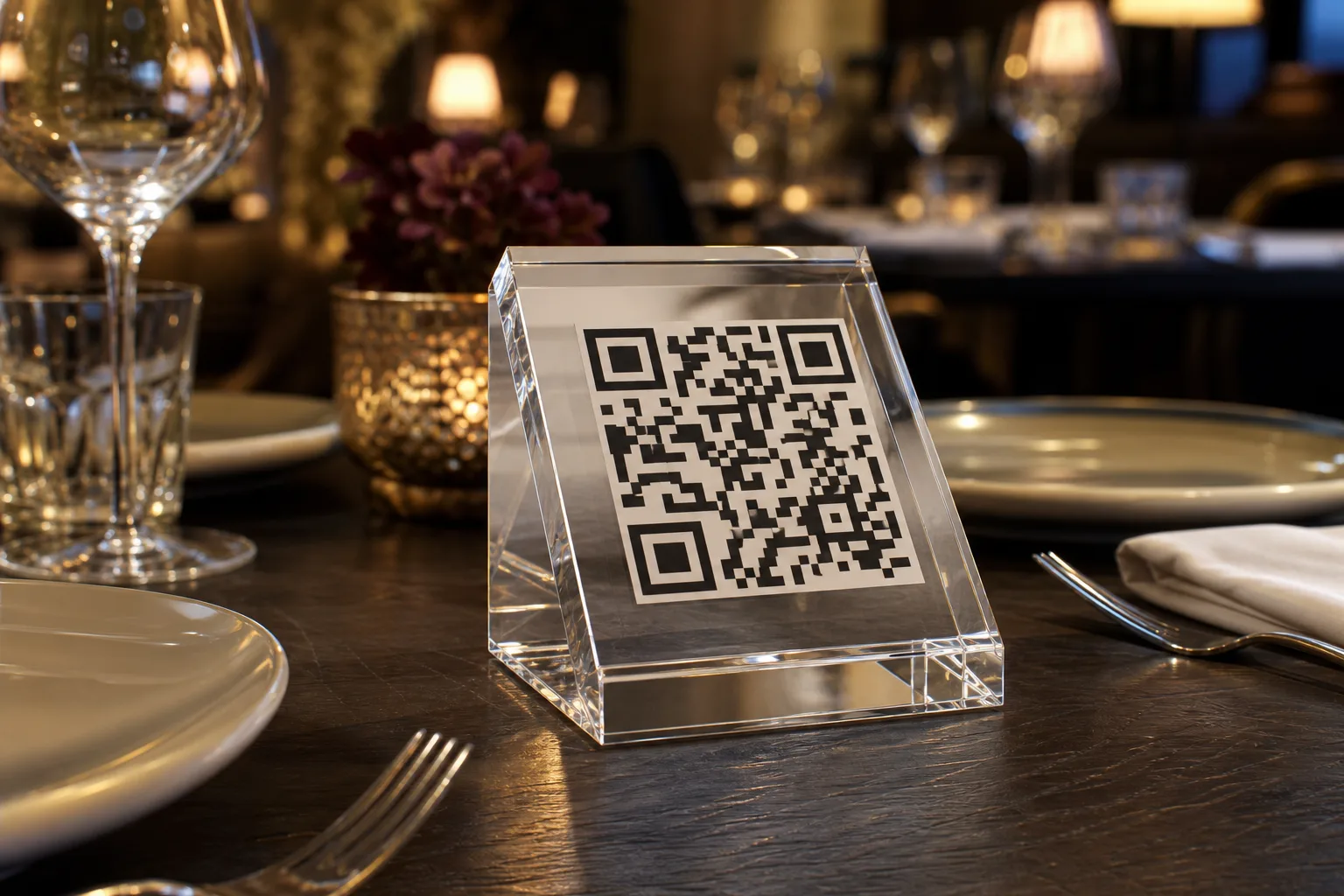
Walk a hotel lobby at check-in time and you can watch the product requirement write itself. An acrylic QR code stand is a clear, rigid holder that keeps a scannable code upright, angled, and legible at the point a guest actually uses it — a restaurant table, a hotel front desk, a guest-room console. Three forms cover nearly every deployment: the L/T-shaped stand, the solid angled block, and the wall-mounted holder.
A guest steps to the desk, phone already in hand; the clerk gestures at a curling laminated card taped beside the card reader; the guest tilts the phone, catches the ceiling lights on the lamination, moves a coffee cup, tries again. Every failed scan is four seconds of awkwardness, multiplied across every guest, every day. When I visit client properties, that taped card is what I am usually there to replace — and the replacement is rarely complicated. It is one of three shapes, sized to its scene.
| Form | Geometry | Best scene | Typical spec |
|------|----------|-----------|--------------|
| L / T-shaped stand | Bent or slotted upright on a flat foot | Restaurant tables, café counters | 3-5mm acrylic, 70-100mm wide, single or double-sided |
| Solid angled block | One solid piece, face cut at an angle | Front desks, bars, premium tables | 15-25mm thick block, 30-60 degree face |
| Wall-mounted holder | Flat plate or pocket on standoffs/tape | Corridors, elevators, room entries | 3mm acrylic, screw or VHB tape mount |
Side profiles of the three acrylic QR code stand forms. The L-stand trades mass for a flat foot; the solid block is stable by sheer thickness with its face cut at 30-60 degrees; the wall holder removes the tip-over question entirely.
The forms are not interchangeable, and the scene picks first. Tables need small footprints that survive bussing; a front desk rewards the visual weight of a polished solid block — the same presentation logic as our [acrylic sign holders](/products/acrylic-displays/acrylic-sign-holders/), which share DNA with the L-stand form. Corridors and elevator banks want [wall-mounted holders](/products/acrylic-displays/wall-sign-holders/) that nobody can walk off with. Most hotel programs end up ordering two or three forms under one artwork standard, which is exactly how we quote them.
---
## Swappable insert vs direct print {#insert-vs-print}
Decide by change frequency. If the code's destination URL is stable — and with a dynamic QR service it can stay stable forever — direct printing is cleaner, permanent, and tamper-proof. If the printed card rotates with seasons, promotions, or languages, an insert slot swaps content in seconds without touching the stand.
The insert-slot stand is the familiar table-tent pattern: a folded or slotted acrylic body holding a printed card, guest-facing on both sides. Its strength is operational — a restaurant reprints a card stock sheet, not an acrylic order, every time the menu shifts. Its weaknesses are equally operational: cards curl in humidity, slide out of square, and invite fidgeting fingers. A code printed straight onto the acrylic cannot be pulled out, swapped by a prankster, or reinserted upside down — a real consideration for payment-linked codes, where a maliciously swapped card is a fraud vector, not a housekeeping issue.
The decision most buyers under-weigh: a QR code does not have to change when the content changes. A dynamic QR points at a redirect the operator controls, so the printed pattern stays fixed while menus, wine lists, and promo pages change behind it. Brief that correctly and the "we might change the menu" argument for inserts mostly dissolves — which is why the majority of restaurant table programs we produce end up direct-printed, and insert slots persist where genuinely different physical cards rotate: multi-language welcome cards, event schedules, seasonal one-pagers.
Direct UV print on a solid angled block: nothing to curl, swap, or straighten. The code angles toward a seated guest, and the printed face sits where a phone naturally points.
---
## Get the code right before printing 1,000 of it {#qr-artwork-rules}
The acrylic can be perfect and the deployment still fails if the code artwork is wrong. Three specs decide scannability: a quiet zone four modules wide kept absolutely clear around the code, strong dark-on-light contrast, and the lowest QR version — the fewest modules — your data allows.
The quiet zone is the margin of clear space the QR standard requires on all four sides of the symbol — four modules wide, where nothing is printed.[^denso-margin] It is also the spec most often violated by enthusiastic branding: a logo tucked against the code's edge, a border box for visual polish, a background pattern running underneath. Each one eats the margin the scanner needs to find the symbol. The QR code symbology itself is standardized under ISO/IEC 18004,[^iso-qr] and the version system runs from 21x21 modules up to 177x177[^denso-version] — the more data encoded, the more and finer the modules. A shortened redirect URL drops the version, which means bigger modules at the same print size, which means faster scans from further away in worse light. Short URL, big modules, clear margin: that is the whole artwork recipe.
Materials add one wrinkle worth knowing. Clear cast acrylic transmits about 92% of visible light,[^optix-lt] which is exactly why it presents printed codes so well — but a glossy first surface can throw specular glare under downlights. Two production answers exist: print the code on a matte or frosted face, or print second-surface (behind the acrylic) so the gloss sits in front of a protected image. On sample approval, we tell every buyer the same thing: take the physical sample to a real table, under the real evening lighting, and scan it with three different phones. Five minutes, and it settles every theoretical argument in this section.
---
## Bases that do not tip {#tip-over}
Tip-over resistance is geometry: base footprint generous relative to height, thickness matched to size, and mass low. A table stand that wobbles when the table is wiped will be knocked flat daily, scratched weekly, and replaced by Christmas — the shabbiest failure a nice restaurant can buy.
The physics is unforgiving but easy to buy correctly. Keep the upright short relative to the foot, and step material up as the stand grows: 3mm acrylic is fine for a compact table stand, but a taller front-desk piece wants 5mm so the upright does not flex and the foot carries real mass. Solid angled blocks solve stability by brute mass — a 20mm-thick block is essentially un-tippable by a passing sleeve, which is one reason the form reads as premium. For service environments we also specify rounded corners and polished edges as standard: a table stand gets grabbed, stacked, and wiped a hundred times a week, and sharp corners on 3mm acrylic are unkind to both guests and bus cloths.
Since founding Wetop in 2008 I have watched this category migrate from an afterthought — a folded PVC tent someone ordered from a print shop — to a specified fixture on hospitality fit-out schedules, and the tip-over line is usually what forced the upgrade. Operations managers do not write specs for things that behave; they write specs for the thing that fell over into the bread basket in front of a table of eight.
---
## Holding one standard across 1,000 units {#print-consistency}
At chain-rollout volume the question changes from "does it look good" to "is unit 950 identical to unit 5." For one-color codes, silk-screen printing is the volume answer: one screen, one ink batch, one lay-down thickness across the run. Full-color branding runs UV digital with register checks through production.
Silk screen earns its place at exactly this scale. The screen is made once, the ink is batched once, and every pass lays the same film of ink — so the thousandth code carries the same edge sharpness and density as the first, with no drift for a scanner to notice. Setup has a fixed cost, which is why screen printing quotes poorly at 50 pieces and beautifully at 1,000. UV digital inverts the math: no setup, any color count, unit-level flexibility — the right tool for a boutique's 80 stands with full-color branding, or for runs where each property gets its own code. Many hotel programs split the work across both methods on one order: screen-printed codes, UV-printed brand marks. Our [UV printing on acrylic guide](/guide/uv-printing-on-acrylic/) covers the digital side of that pairing in production depth.
Consistency is also a QC discipline, not just a print method. Every order leaving our factory passes 100% piece-by-piece inspection, and for QR work that inspection includes the only test that matters: scanning. A code that reads 99% of the time sounds acceptable until you multiply it across a thousand tables and every scan failure becomes a guest waving at a server. Our [restaurant menu holder rollout](/case-studies/acrylic-menu-holders-restaurant-chain/) shows what this looks like across a chain program — same discipline, adjacent product.
---
## Specs by scene: table, front desk, guest room {#specs-by-scene}
Hospitality QR programs succeed scene by scene, and each scene has a sensible default spec. Tables take compact, double-sided, direct-printed stands; front desks take solid blocks with brand presence; guest rooms take small, quiet pieces that sit with the amenity set rather than shouting over it.
| Scene | Recommended form | Size guidance | Print approach |
|-------|-----------------|---------------|----------------|
| Restaurant / café table | Angled block or low L-stand | 70-100mm wide, compact footprint | Direct print, double-sided for four-tops |
| Bar / counter | Angled block | 15-25mm thick, 30-60 degree face | Direct print, second-surface for gloss |
| Hotel front desk | Solid block or L-stand, 5mm+ | Larger footprint, branded | UV print brand + screen or UV code |
| Guest room / console | Compact block or small stand | Small, low-profile | Direct print, matte face |
| Corridor / elevator | Wall-mounted holder | 3mm plate, screw or VHB mount | Insert slot or direct print |
Guest rooms deserve one extra sentence, because they are the scene hotels most often get wrong. A room QR piece — WiFi access, room service, checkout — lives inches from the amenity tray and the phone dock, so it reads as part of the room's design language. A compact matte-finished block in the property's palette belongs there; a glossy sales-desk stand does not. Hotel procurement teams that already buy custom amenity trays typically fold QR pieces into the same order and the same finish standard — one supplier, one color language across the room; our [hotel amenity tray program guide](/guide/hotel-amenity-vanity-tray-program/) covers how those room-goods programs are structured. The full range of forms lives on our [acrylic displays](/products/acrylic-displays/) hub.
---
## Ordering for one property or a hundred {#ordering}
The commercial terms are built for exactly this category's buyers: MOQ 50 pieces per design, samples in 3-5 days with the sample cost credited to your first order, production in 15-20 days with 100% inspection, and a 30% deposit with the balance before shipment. FOB Shenzhen standard; DDP to your door quoted on a ZIP code.
Fifty pieces covers a single restaurant's tables with spares, so independents are not locked out — and the same spec scales to a hotel group's thousand-unit rollout without re-engineering, because CNC-cut acrylic carries zero tooling fees at any tier.
Group rollouts have a rhythm we have learned to plan around. Most chains do not order a thousand units on day one: they pilot one property with 50-100 pieces, live with them through a full service cycle, adjust one or two details — the face angle, the finish, the insert decision — and then release the volume order against the approved sample. We hold the approved spec, the print files, and the color standard on file, so property two through forty repeat without a second sampling round, and replacement orders years later still match the originals. Budget holders like the shape of that curve: the pilot risks a few hundred dollars, and the rollout inherits a spec that has already survived real guests.
Since 2008 I have seen plenty of hospitality fixtures come and go, but this one is a structural keeper — the QR code has become the front door to menus, payments, WiFi, and check-in, and the stand holding it is now part of a property's first impression. The efficient brief is short: which scenes (table, desk, room, wall), the code or URL for each, artwork files or just a logo, target quantity per scene, and your opening date. [Send us that brief](/contact/) — a photo of the table setting helps more than you would think — and we return an itemized quote within 24 hours, with a sample on your actual table inside a week.
[^denso-margin]: [Point for determining the code area — QRcode.com (DENSO WAVE)](https://www.qrcode.com/en/howto/code.html) — the QR inventor's own sizing guidance, documenting the required quiet zone of four modules on all sides of a symbol.
[^iso-qr]: [ISO/IEC 18004 — QR code bar code symbology specification](https://www.iso.org/standard/83389.html) — the international standard defining QR code symbology, referenced for the code structure that stand artwork must respect.
[^denso-version]: [Information capacity and versions of QR Code — QRcode.com (DENSO WAVE)](https://www.qrcode.com/en/about/version.html) — documents QR versions 1-40 spanning 21x21 to 177x177 modules, the data-to-module relationship behind the short-URL recommendation.
[^optix-lt]: [Plaskolite OPTIX acrylic sheet product data sheet](https://plaskolite.com/docs/default-source/pds/pds322_opx_gp_metric.pdf) — manufacturer datasheet listing cast acrylic sheet at 92% total light transmission per ASTM D1003, the optical figure cited for QR display stands.