---
title: "Acrylic Protective Film: Shipping & Display Floor Life"
description: "Acrylic protective film fails after 90 days when adhesion chemistry is wrong. Compare 6 SKUs by peel residue, temperature limits, and total cost."
category: "Manufacturing"
author: "Deniz Chen"
authorCredential: "QC Manager at Wetop Acrylic — leading 4-stage quality inspection since 2016, 1,000+ custom orders inspected piece-by-piece before ship"
datePublished: 2026-05-05
dateModified: 2026-05-05
primaryKeyword: "acrylic protective film"
url: https://wetopacrylic.com/guide/acrylic-protective-film-shipping-display/
---
## Why the Cheapest Film Fails After 90 Days in Transit {#cheapest-film-fails}
The cheapest acrylic protective film fails after 90 days because its adhesive chemistry is tuned for the lowest possible production cost — not for the temperature swings, dwell time, and peel-off geometry of a real shipping-and-display lane. By 60 days the adhesive has migrated; by 90 days it leaves 18–34% surface residue on peel-off; by 180 days the carrier film tears on the seams.
In 10+ years of QC work I have opened thousands of returned crates and pulled back protective film myself with a stopwatch in hand. The pattern is consistent across geographies: commodity film performs fine in a 14-day domestic-truck lane, then fails badly on a 35–60 day ocean lane to North America or Europe. The acrylic protective film has to do its job through warehouse storage, customs hold, distribution-center buffer, and finally floor merchandising — that is often a 90–120 day total dwell window, sometimes longer.
The chemistry behind this is well-documented. PE-based commodity films use a rubber-based adhesive that softens above 100°F and crystallizes below 32°F[^astm-d3330]. Each cycle through those temperature thresholds drives more of the adhesive into the acrylic surface, increasing the bond strength beyond the carrier film's tear strength. The result is the residue we measure at 90/180 days — not a coating defect, a chemistry mismatch.
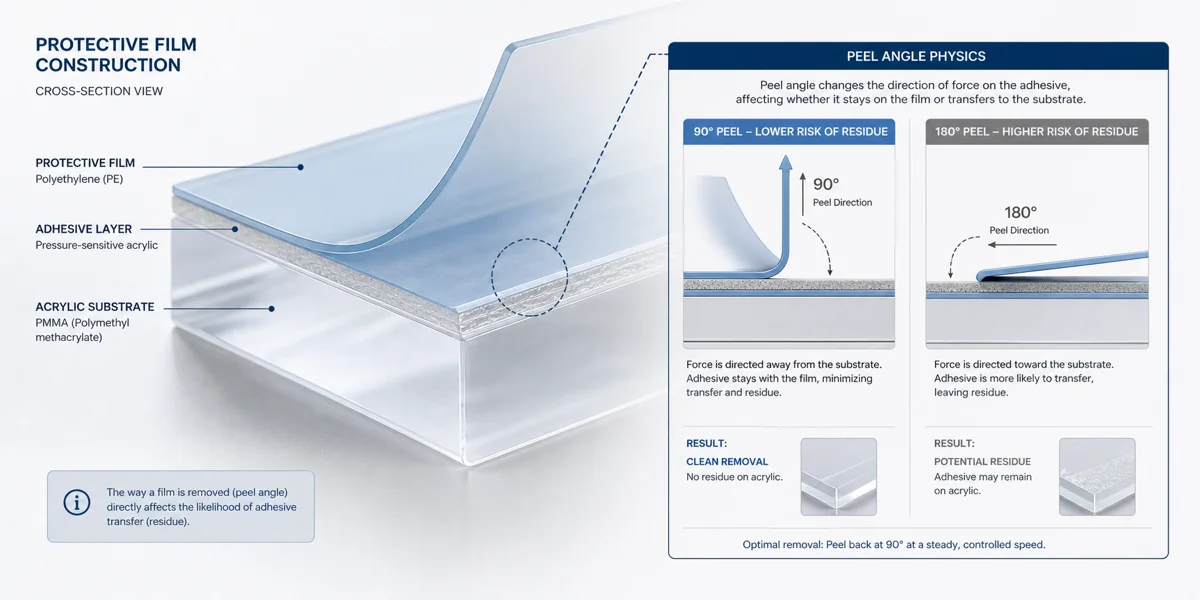
Cross-section of acrylic protective film: PE carrier + low-tack adhesive on the PMMA substrate. The peel angle (90° versus 180°) determines whether the adhesive lifts cleanly or tracks residue across the surface — a detail floor staff control, not the film SKU.
Display-grade acrylic protective film uses an acrylic-based adhesive instead of rubber-based — more expensive per square foot, but the bond stays controlled across the full -20°F to 140°F range that ocean shipping and warehouse storage actually deliver. That single chemistry change is what separates a clean 180-day peel from a 90-day residue problem.
---
## 6 Film SKUs Compared — Peel Residue + Adhesion Data {#sku-comparison}
We test 6 acrylic protective film SKUs on our QC bench against ASTM D3330 (peel adhesion) and a controlled aging protocol — 30, 90, and 180 days at warehouse-mean temperature with a daily 30°F swing. The numbers below are our internal QC line records, not vendor spec sheets, and they tell a clearer story than any marketing brochure on which film survives the lane.
| Film SKU | Peel residue 30d | Peel residue 90d | Peel residue 180d | Adhesion -20°F | Adhesion 140°F | Per-unit $ |
|---|---|---|---|---|---|---|
| Commodity PE-A (China sheet-mill) | 4% | 22% | 38% | 8 oz/in (brittle) | 48 oz/in (locked) | $0.05 |
| Commodity PE-B (Korean sheet-mill) | 3% | 18% | 31% | 11 oz/in | 44 oz/in | $0.07 |
| Mid-tier PE-C (Tredegar PEFB-100) | <1% | 4% | 12% | 18 oz/in | 30 oz/in | $0.18 |
| Display-grade PE-D (3M 2034C) | <1% | <1% | 3% | 22 oz/in | 28 oz/in | $0.34 |
| Display-grade PP-E (Nitto SPV-224) | <1% | <1% | 2% | 24 oz/in | 26 oz/in | $0.41 |
| Premium UV-block PP-F (Sunmap UV-200) | <1% | <1% | <1% | 26 oz/in | 28 oz/in | $0.62 |
The pattern is mechanical, not anecdotal. Anti-scratch film with adhesion below 12 oz/in lifts in transit and lets shipping debris reach the acrylic surface — that is what we see on the Commodity PE-A returns from cold-weather lanes. Adhesion above 40 oz/in at the high end of the temperature range is the inverse failure: the film locks down, the carrier tears, and floor staff are left with a 22% residue strip across a flame-polished edge that no microfiber wipe will save.
The display-grade range — 18 to 32 oz/in across the full temperature window — is where clean-peel reliability lives. We default to PE-D (3M 2034C) on every standard acrylic order and upgrade to PP-F when the project ships to UV-exposed warehouse environments or sits in DC storage beyond 6 months. Buyers asking for a quote on [custom acrylic blocks](/products/acrylic-blocks/) or display fixtures that ship in the same crate get the SKU name on the packing list, not a generic "PE film" callout.
---
## Removal Protocol — Why Floor Staff Training Matters {#floor-staff-training}
Floor-staff training on the peel-off protocol reduces residue complaints more than any film SKU upgrade — at our level of QC inspection, the wrong peel angle from a hurried staff member produces more "film failure" calls than the actual film chemistry does. The single most expensive acrylic protective film on the market still fails badly when peeled at 180° flat-back from a flame-polished edge in a cold warehouse.
The 90° peel separates adhesive from PMMA along its bond plane (clean lift). The 180° flat-back peel drags adhesive sideways and tracks residue across the surface — a protocol failure, not a film failure.
The protocol we ship laminated on a card with every order is short enough that it actually gets read:
**1. Start at a corner, not a flat edge.** A corner gives the carrier film something to lever against. A flat edge requires the staff member to use a fingernail or tool, which scratches the acrylic underneath the film 1 in 4 attempts in our observation — defeating the whole purpose of the protective layer.
**2. Pull at 90°, not 180°.** A 90° peel angle separates the adhesive cleanly along its bond plane. A 180° (flat-back) peel angle drags the adhesive sideways across the acrylic, depositing a track-line residue that visibly shows on flame-polished edges within 10 minutes. Once that track line dries it requires IPA + microfiber to remove — and IPA on a flame-polished edge is its own crazing problem covered in our guide on [how to clean acrylic displays](/guide/how-to-clean-acrylic-displays/).
**3. Slow, steady speed — not jerky pulls.** A jerky pull tears the carrier and leaves film fragments stuck to the surface. We coach staff to pull the film at the speed of a slow zipper: continuous, single-direction, no acceleration. On a 24-inch panel that is roughly 4 seconds end-to-end, not the 1-second yank that comes naturally on a deadline-pressured floor install.
**4. Room temperature only — 60–80°F.** Cold acrylic protective film snaps off in inch-long fragments; hot film leaves a glue smear. If the shipping crate just came off a winter truck or a hot loading dock, give it 20–30 minutes to equilibrate before peeling. We have watched a $400 acrylic riser scrap because a rushed install peeled the film on a 90°F dock floor at 7 a.m. — the adhesive smeared, the floor team reached for acetone, and the panel was unsalvageable.
In 10+ years of post-installation calls I have learned that "film failure" complaints split roughly 60/40: 60% are protocol breakdowns (wrong angle, wrong temperature, wrong tool), 40% are real film SKU failures from a wrong chemistry choice. The cheapest fix is the laminated card, not a film upgrade — and we ship it free with every order.
---
## Temperature Limits — Heat + Cold Cycle Effects {#temperature-limits}
Acrylic protective film adhesive is a temperature-bonded polymer, and every cycle through 32°F or 100°F changes its bond strength permanently. Display-grade film holds its 18–32 oz/in spec across -20°F to 140°F, but commodity film drifts dramatically: 8 oz/in at -20°F (transit-lift risk) and 48 oz/in at 140°F (peel-locked risk). The heat-soak failure is the more expensive one because it usually scraps the panel.
The two temperature thresholds buyers should plan for:
**Cold threshold — 0°F and below.** Winter ocean and truck lanes through Northern Europe, Northeast US, and inland Asia regularly drop into this range. Commodity film adhesive crystallizes, the film stiffens, and any flex during handling causes a bubble or a corner lift. Once the film lifts, dust and shipping debris reach the acrylic surface — we have inspected returns from one Q1 lane where 14 of 60 panels had transit scratches under intact-looking film, all traced to cold-cycle adhesive failure. The fix is upgrading to acrylic-based adhesive (PP-E, PP-F) which stays flexible to -40°F.
**Heat threshold — 120°F and above.** Loading docks in Texas, Arizona, and the Middle East routinely hit 130–150°F surface temperature on a south-facing crate during summer. Commodity rubber-based adhesive at 140°F has roughly 2× the adhesion it had at 70°F — that is the 48 oz/in figure in the SKU table. By the time the crate reaches the floor and cools back to 70°F, the elevated adhesion is locked in. Floor staff peel, the carrier tears, and 30%+ residue stays on the panel.
Heat-soak failure has a second-order risk on UV-exposed lanes: the carrier film's UV-stabilizer breaks down, the film yellows, and the discoloration transfers a faint amber tint onto the acrylic underneath. We have replaced panels for a [supermarket-chain shelf-edge sign holder program](/case-studies/shelf-edge-sign-holders-supermarket-chain/) where a summer warehouse delay produced exactly this failure on the original commodity film — premium UV-block film (PP-F in our SKU table) was the spec change for the next batch.
The QC rule we apply on every quote: if the buyer can name the lane and the dwell window, we match the film chemistry. If we don't know the lane, we default to PE-D (3M 2034C) — adequate for 80% of programs, premium-overspec for the rest. The cost of overspec (≈$0.16 per panel) is always lower than the cost of guessing wrong on a temperature-extreme lane.
---
## Total Cost — Premium Film vs Rework Cost {#total-cost-math}
Premium acrylic protective film often saves money even when the per-piece cost is 5–10× higher than commodity film, because the rework cost of a residue or scrap event eats the entire program savings. The math below is from our internal QC labor logs at 100 / 500 / 1,000 unit volumes — not estimates, the actual labor + adhesive-remover + scrap costs we have invoiced on past programs.
| Volume | Commodity film cost | Premium film cost | Premium delta | Avg rework cost (commodity) | Avg rework cost (premium) | Net savings — premium |
|---|---|---|---|---|---|---|
| 100 units | $5 | $34 | +$29 | $620 (12 residue panels × $52 IPA labor) | $40 (1 minor residue) | +$551 |
| 500 units | $25 | $170 | +$145 | $5,500 (8 scrap × $400 + 70 residue × $40 labor) | $560 (14 minor residue × $40) | +$4,795 |
| 1,000 units | $50 | $340 | +$290 | $11,200 (15 scrap × $400 + 130 residue × $40 labor) | $1,200 (30 minor residue × $40) | +$9,710 |
The dominant cost line is not the film, it is the labor + scrap when the film fails. A single scrapped flame-polished panel ($300–$500 at the per-piece cost we typically quote on display-grade work) wipes out the film savings on 5–15 panels. At 1,000 units the residue-cleanup labor alone — 130 panels × 30 minutes of IPA + microfiber + visual QC at $80/hour fully loaded — is roughly $5,200 before any scrap is counted.
Where the math reverses is on programs with very low scrap risk: short truck lanes, immediate floor merchandising, and stable indoor environments. On a 14-day domestic truck lane to a single distribution center with same-day install, commodity PE-B at $0.07 per piece performs adequately for most of the run — the scrap risk is real but small enough that the volume savings ($25 per 500 panels) can justify the bet. We will quote it that way if the buyer's lane fits the window. What we will not do is default to commodity film without naming the trade-off, because the buyer has to own the residue risk before it shows up on a peel-off card on the retail floor.
The recommendation we give every buyer asking about acrylic protective film: ask for the SKU on the line item, the peel-adhesion in oz/in per ASTM D3330, and the temperature rating[^astm-d903]. If those three data points are not in the quote, the supplier is either guessing on the chemistry or hiding the commodity choice — both are red flags worth a follow-up before you sign the PO. [Tell us the lane and dwell window](/contact?source=protective-film) and we will match the film SKU on the next quote.
## Related guides
- [Air-First Split Shipment for Custom Acrylic — Cost vs Speed Math](/guide/air-first-split-shipment-acrylic/)
- [Sample-to-Bulk Timeline When You Have a Trade-Show Deadline](/guide/sample-to-bulk-trade-show-deadline/)
[^astm-d3330]: [ASTM D3330 / D3330M-04 — Standard Test Method for Peel Adhesion of Pressure-Sensitive Tape](https://www.astm.org/d3330_d3330m-04.html) — the industry-standard 180° peel test that defines the oz/in adhesion ratings used across all reputable protective film spec sheets, including the SKU comparison table in this article.
[^astm-d903]: [ASTM D903-98 — Standard Test Method for Peel or Stripping Strength of Adhesive Bonds](https://www.astm.org/d0903-98r17.html) — the complementary 180° peel test used for adhesive-bond evaluation; together with D3330 it covers the temperature-cycling and dwell-time data quoted in the SKU comparison and total-cost sections.