---
title: "Acrylic Mahjong Set OEM: The Full-Bundle Guide"
description: "Every line item in a full acrylic mahjong set OEM bundle — specs and price bands for tiles, cases, racks, mats, and bags, plus mixed-order MOQ math."
category: "Buyer Guide"
author: "Amy Liu"
authorCredential: "Client Account Manager at Wetop Acrylic — coordinating B2B orders from first inquiry through delivery since 2020, 500+ custom projects handled"
datePublished: 2026-07-20
dateModified: 2026-07-20
primaryKeyword: "acrylic mahjong set oem"
url: https://wetopacrylic.com/guide/acrylic-mahjong-full-set-oem-bundle/
---
## What "acrylic mahjong set OEM" actually covers {#what-a-bundle-covers}
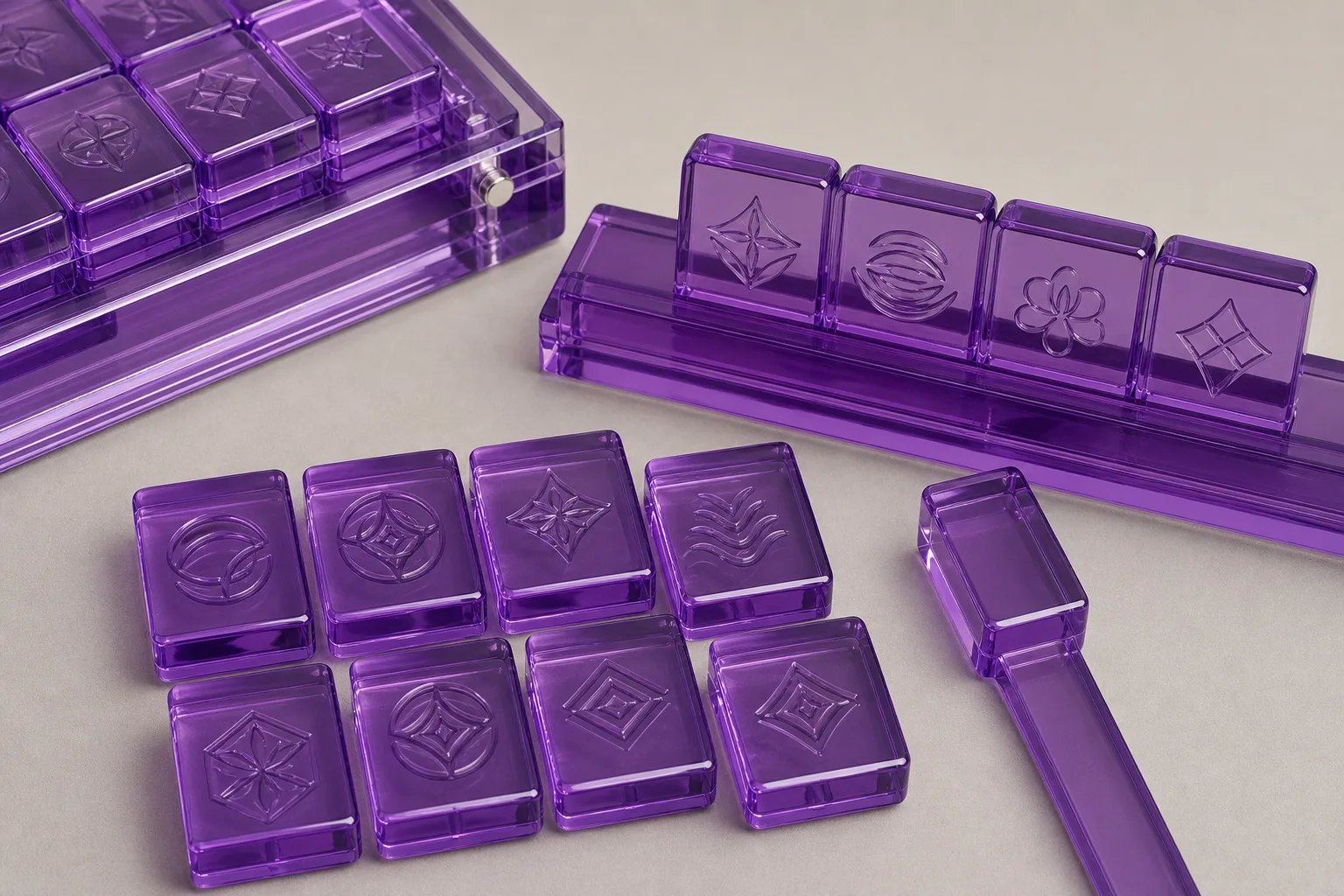
An acrylic mahjong set OEM bundle is a complete, retail-ready game kit — engraved cast acrylic tiles, four racks with pushers, dice, a tile case, a play mat, and a carry bag — manufactured to one brand's spec and shipped as one SKU. Tiles anchor the budget at $40-60 per set in the 50-250 set tier; accessories are itemized on top. Fully custom tiles — your artwork, engraving, and colorways — start at 50 sets with standard packaging and stock accessories; custom packaging and accessory customization start at 250 sets.
Here is the gap I see in bundle inquiries every week: the brief asks for "custom mahjong tiles," but the Amazon listing that brand is competing against ships a kit — tiles, case, racks, dice, mat, bag, giftable box. American mahjong is played with racks as standard equipment,[^wiki-amj] so a tiles-only product is not actually a playable retail offer. Buyers who spec only the tiles discover the other six line items mid-project, when the launch date is already fixed.
This guide is the bundle-side companion to our [custom mahjong ordering guide](/products/acrylic-mahjong/ordering-guide/), which covers the 9-point quote checklist and the step-by-step process. Here the focus is the components themselves: what each one is, what each one costs, which ones we cut in-house, and how the MOQ math works when one purchase order carries six different items.
| Component | What it is | Spec anchor | Price band (50-250 sets) |
|-----------|------------|-------------|--------------------------|
| Tiles | 152 / 160 / 166 engraved cast acrylic tiles | 30x23x13mm to 36x25x15mm | $40-60 per set |
| Racks & pushers | 4-piece acrylic set, 18" industry length | 5mm standard / 6mm heavy | $12.70-14.30 per 4-piece set |
| Dice | 2 standard dice | Included | Custom dice ~$0.30 each |
| Tile case | Acrylic display or travel case, cradle insert | Sized to your tile spec | Quoted per spec |
| Play mat | Slip-resistant fabric table cover | Sized to a card table | Quoted per spec (sourced) |
| Carry bag | Soft canvas or quilted bag, rack compartments | Sized to the loaded case | Quoted per spec (sourced) |
| Packaging | Protective packing included | Printed rigid box from ~500 sets | Included / quoted per spec |
---
## Tiles set the budget — and everything else follows them {#tiles}
Tiles are the anchor component of any acrylic mahjong set OEM order: they carry most of the unit cost, they fix the dimensions of the case and racks, and they set the color standard every other component must match. Get the tile spec locked first; every accessory decision downstream inherits it.
Three decisions dominate the tile line item. First, count: 152 tiles is the American mahjong standard composition[^wiki-amj] played under the National Mah Jongg League's annual card,[^nmjl] 160 adds spare jokers and blanks (the configuration we recommend for retail, because one damaged tile stops being a return), and 166 matches the prevailing Amazon retail standard. Second, size: our standard tiles run from 30x23x13mm compact through 32x23x13mm mid to 36x25x15mm full-size (custom sizes on request), and published size guides show how much feel changes across that range — larger tiles read as premium but raise material weight and case dimensions together.[^gammon] Our [mahjong tile size guide](/guide/mahjong-tile-size-guide/) covers that trade-off in depth. Third, decoration: we engrave the artwork into the tile face and UV-print color into the recess, so the ink sits below the wear surface and shuffling cannot rub it off.
Color construction is the fourth decision, and it is where bundles get their visual identity. Two-tone tiles — a colored back under a light engraving face — come naturally from layered construction; we build the tile from named layers, so your brief just names each layer's color. Stock palette colors are free. A custom-matched Pantone adds a $200-300 one-time setup per color — available from the 50-set floor — and specialty backs like tortoise and pearlescent are available — pearlescent is a specialty grade we confirm on a physical sample before committing a run. For artwork, we work from final vector files (AI or PDF, fonts outlined, colors as Pantone Coated), but we do not make you wait on them: send reference photos and quantities and we quote a reference band the same day, then firm the number when your files land.
One more cost line belongs in your budget from day one: zero. There are no tooling fees on the acrylic side of the bundle — tiles, racks, and cases are CNC-cut and engraved, not injection molded, so a 50-set first run pays for no steel it will never amortize. That single fact is what makes a full-bundle launch viable at boutique quantities, and it is the structural difference between our quote and a molded-set factory's quote with a tooling line buried in it.
---
## The acrylic accessories: racks, pushers, and the case {#acrylic-accessories}
Racks, pushers, and the tile case come off the same cast acrylic stock as the tiles, which is exactly why bundling them works: one material batch means one color standard across every component a customer sees. Racks and pushers run $12.70-14.30 per 4-piece set; cases are quoted per spec because format drives cost.
Racks and pushers are the simplest add: a 4-piece set in 5mm standard or 6mm heavy acrylic, color-matched to the tile backs or run in a contrast palette. The [rack and pusher page](/products/acrylic-mahjong/acrylic-mahjong-rack-and-pusher/) covers formats and standalone options — clubs reordering racks alone is common, and hospitality buyers often add pusher arms to traditional racks.
The case carries more decisions than buyers expect, because "case" means two different products. A travel case is built around a cradle insert that immobilizes 152-166 tiles through freight and daily transport. A display case is built to merchandise the set on a shelf — clear faces, presentation-first geometry. Same material, different engineering; our [mahjong display case page](/products/acrylic-mahjong/acrylic-mahjong-display-case/) breaks down both. When I quote a bundle, the case is the line item I push buyers to decide earliest after the tiles, because its dimensions are hostage to the tile spec: change the tile size after sample approval and the case tooling paths, the cradle insert, and the carry bag sizing all shift with it.
Two standard dice are included with every set; custom-engraved dice add roughly $0.30 each.
One material batch, one color standard: tiles, racks, and case cut from the same cast acrylic stock is what makes a bundle read as a designed product line instead of an assembled one.The three supply lanes inside a full acrylic mahjong set OEM bundle. Acrylic components are CNC-cut in-house; mats, bags, and dice are sourced and consolidated; packaging scales with order size. Everything merges into one inspection pass and one shipment.
---
## Mats and bags: the two components nobody specs {#mats-and-bags}
The play mat and carry bag are the only non-acrylic components in the bundle, and they are the two your brief is most likely to leave blank. We source both through accessory suppliers we have vetted on prior bundles, then consolidate them at our factory so the whole kit passes one inspection and ships as one order.
Honesty matters here, so let me be plain about what we do and do not make. We are an acrylic fabricator — an acrylic factory that claims to also weave fabric in-house should raise your eyebrows. What we own is the spec, the QC, and the consolidation: the mat and bag are produced to your colorway by suppliers we have already run bundle orders through, inspected alongside your tiles, and packed into the same cartons.
On specs, follow the US retail market rather than inventing from scratch. Established mahjong retailers sell table covers and dedicated mahjong bags as standard accessory categories,[^wtwb] and the retail conventions are consistent: a slip-resistant fabric cover sized to a standard card table so tiles do not skate or clack, and a soft-sided canvas or quilted bag with internal compartments shaped around the loaded case and four racks. Across the bundle programs I have coordinated since 2020, exactly one buyer has sent me a finished mat spec — every other mat and bag started from a reference photo of a competitor's kit, and that is a perfectly good way to brief it. Send the photo, name your colorway, and we translate it into a supplier spec with your tile palette carried through.
The mat and bag are also where a brand quietly differentiates. Tiles from any competent fabricator look premium; a mat in the brand's exact palette with an embroidered logo bag photographs as a designed product line rather than an assembled one.
---
## How MOQ works when one order mixes six SKUs {#bundle-moq}
Bundle MOQ keys to the anchor component: 50 tile sets per design. Accessories bundled to those sets ride at the set count — 50 bundles means 50 cases, 50 mats, 50 bags, and 200 rack-and-pusher pieces on one purchase order, with no separate minimum applied to each accessory line.
The question I get most on mixed orders is whether each component carries its own floor — whether 50 sets of tiles plus 50 bags somehow requires 100 of something. It does not. The 50-set minimum exists because CNC programs, engraving setup, and color batching have fixed costs that a smaller run cannot absorb; once a bundle order clears that bar on the tiles, the accessories are riding on setup that is already paid for. One design, 50 sets, every accessory quoted at the set count. The configuration gate rides on top of that floor: 50-200 set bundles ship standard-spec accessories, and full-kit accessory customization — custom rack geometry, custom mats, custom case specs — opens at 250 sets.
Reorders inherit the same logic, with one useful asymmetry I point out on almost every kickoff call: accessories wear out at different rates than tiles. A club or a brand's repeat customers lose bags to zippers and mats to spills long before an engraved acrylic tile shows wear, so second orders are often accessory-heavy — 50 more bundles plus 150 standalone rack sets and 200 replacement bags is a normal-looking PO from a brand in its second year. Because we keep the CNC programs, engraving files, and supplier specs from the first run on file, a reorder skips the setup conversation entirely: same design, same color standard, quote in 24 hours.
Three edge cases are worth knowing before you write the PO. First, uneven quantities are fine in one direction: 50 bundles plus 100 extra rack sets for replacement stock quotes cleanly, because the extras still sit on the same production setup. Second, standalone accessory orders — racks alone, no tiles — follow the accessory's own minimum, which is 50 sets of 4 for rack-and-pusher products. Third, colorways multiply designs: 50 sets split across two colorways is two 25-set runs, under the per-design floor. If your launch needs two colorways, plan 50 sets of each, and note that reorders repeat the same math — the [designer mahjong set case study](/case-studies/designer-mahjong-set-oem-promotional-brand/) shows how a promotional brand structured exactly this kind of multi-component first order.
---
## Samples, payment, and the bundle calendar {#samples-payment-timeline}
Sample the tiles, not the bundle. Tile samples run three tiers — a $40-80 single engraved tile in 5-7 days, a $180-320 12-tile color-register check in 7 days, or a $300-500 full set sample with air freight in 7-10 days — and none of the fees credit back, because one-off engraving and finishing labor far exceeds the fee.
That no-credit policy is the opposite of our standard-product sample track, where a simple display or tray sample credits against the first order, so I explain it on every mahjong quote before anyone asks. A custom mahjong sample is not a unit pulled off a production line: it is CAM programming, engraving setup, and print calibration executed once, for one piece. The fee recovers a fraction of that labor. What you are buying is certainty — proof of the engraving depth, the color register, and the tile feel before 50-250 sets go into production against your artwork.
Money and calendar, in order. Payment is a 40% deposit with the balance before shipment — the mahjong-cluster exception to our site-wide 30% standard, reflecting the higher share of custom labor sunk into every run. Production runs 15-25 days for a full bundle; we source mats and bags in parallel with tile production, so on a typical first order the fabric lane costs no extra calendar time. Sea freight adds 25-35 days to a US port, and DDP door pricing locks once we have the destination ZIP and the final configuration weight. Stack it end to end — sample round, deposit, production, freight — and a realistic first-order timeline is 60-75 days from deposit to warehouse.
Two calendar habits separate smooth bundle launches from stressful ones, and we see both play out every season. Brands that treat the sample round as part of the schedule — ordering the single-tile sample while artwork is still in revision — effectively run the two clocks in parallel and give the calendar a week back. And brands that lock the case format at the same time as the tile spec avoid the most common mid-project stall we see: a tile-size revision at sample stage that quietly re-opens the case drawing, the cradle insert, and the bag sizing behind it. We flag both on every first-order kickoff because they cost nothing to do early and a week each to do late.
Start from the [acrylic mahjong hub](/products/acrylic-mahjong/), or [send us your reference kit photos](/contact/), quantities, and launch date — we reply with an itemized bundle quote within 24 hours.
[^wiki-amj]: [American mahjong](https://en.wikipedia.org/wiki/American_mahjong) — documents that American mahjong is played with racks as standard equipment and uses a 152-tile composition, which is why a retail-ready product is a kit rather than tiles alone.
[^nmjl]: [National Mah Jongg League — The Game](https://www.nationalmahjonggleague.org/game.aspx) — the league behind the American mahjong standard whose annual card defines tournament play.
[^gammon]: [What Size Are the Tiles? — GammonVillage](https://www.gammonvillage.com/mah-jong-shop/learn/what-size-are-the-tiles.cfm) — retailer size guide documenting how mahjong tile dimensions vary across market segments, supporting the size-range trade-off discussion.
[^wtwb]: [Where The Winds Blow — US mahjong retailer](https://www.wherethewindsblow.com/) — established US mahjong specialty retailer whose catalog carries table covers and mahjong bags as standard accessory categories, the retail convention referenced for mat and bag specs.