---
title: "Acrylic Gift Box Sizes: How to Spec the Right Fit"
description: "Acrylic gift box sizes explained — inside vs outside dimensions, clearance rules, standard size bands, thickness pairing, and nesting to cut freight cost."
category: "Buyer Guide"
author: "Amy Liu"
authorCredential: "Client Account Manager at Wetop Acrylic — coordinating B2B orders from first inquiry through delivery since 2020, 500+ custom projects handled"
datePublished: 2026-07-15
dateModified: 2026-07-15
primaryKeyword: "acrylic gift box sizes"
url: https://wetopacrylic.com/guide/acrylic-gift-box-size-guide/
---
## Size the box from the inside out {#inside-dimensions}
Acrylic gift box sizes are specified by interior dimensions — the clear space the product actually occupies — not by the outside of the box. With standard 5mm walls, outside dimensions overstate usable space by 10mm on length and width and 5-10mm on height. Spec the interior, label it "ID," and the box fits on the first sample.
An acrylic gift box is a clear or colored rigid packaging box, CNC- or laser-cut from cast acrylic sheet and bonded into a five-sided body with a hinged, lift-off, or sliding-drawer lid. Because every box is cut to order, "what size does it come in" is really "what size should it be" — and that answer starts with the product going inside, not with a catalog.
Here is the gap I see on quote requests every single week: the brief says "we need a 15x15x8cm acrylic gift box," and nothing else. Is that the space the candle jar needs, or the footprint the retail shelf allows? Those are different boxes. Six years of coordinating gift-box orders taught me to ask one question before anything gets quoted: what exactly goes inside, and how snugly should it sit? A brief that answers that in the first email saves a full clarification round — often two to three days on the sample clock.
The wall does the stealing. A 5mm-wall box quoted at 150x150x80mm outside gives you 140x140mm of floor and, once the base is subtracted, about 75mm of height. A rigid 140mm product now has zero clearance. Flip the spec to "interior 150x150x80mm" and the outside grows to 160x160x85-90mm — which is fine, unless a shelf or a shipping carton constrains the outside too. When both matter, state both, and tell us which one is fixed.
State your units while you're at it. We quote in millimeters; briefs arrive in inches, centimeters, and occasionally both in the same line. A box built to 6cm when the buyer meant 6 inches is a 152mm error — write "mm," "cm," or "in" after every number and the mistake becomes impossible.
---
## The clearance math: item + insert + allowance {#clearance-math}
Interior size is a three-term sum: the item's dimensions, plus the insert wall around it if there is one, plus a fit allowance so the item lifts out without a fight. For a bare rigid item that means 2-3mm per side; with a die-cut foam or velvet insert, 8-12mm per side.
The three sums behind every acrylic gift box size, drawn to scale for a 90mm item in a foam insert: 2mm cavity clearance and a 10mm insert wall per side set the 114mm interior, and 5mm acrylic walls set the 124mm exterior.
The allowance depends on what the box holds and how it should present. A candle jar resting directly on the acrylic floor wants just enough slack to drop in and lift out — 2-3mm per side. A bracelet in a velvet-covered foam tray needs the tray itself: the foam body typically adds 8-12mm per side, and the cavity inside it is cut 1-2mm larger than the item so velvet compresses gently around it. Soft goods — a folded scarf, a pair of gloves — compress and rebound, so measure the folded stack, add about 5mm, and let the lid do the final press.
| What's inside | Fit style | Allowance per side | Height allowance |
|---|---|:---:|:---:|
| Rigid item, no insert (jar, tumbler, award) | Drop-in | 2-3mm | 3-5mm above item |
| Rigid item in die-cut foam insert | Cradled | 8-12mm (insert + cavity) | Insert base 10mm + item + 3mm |
| Jewelry in velvet tray | Presented | 10-15mm | Tray 20-30mm + item |
| Soft goods (scarf, apparel) | Compressed | 3-5mm | Folded height + 5mm |
| Multi-item set | Compartmented | 10mm between cavities | Tallest item + 5mm |
I ask buyers to run the sum in one direction only — from item to interior to exterior — and to write all three lines in the brief. A complete size spec reads like this: *item 90x90x110mm; interior 110x110x125mm with die-cut foam insert; exterior approximately 120x120x130mm at 5mm walls.* Any factory reading that line knows exactly what to build, and the sample that arrives in 3-5 days confirms it physically before the 50-piece-minimum production run commits.
---
## Standard size bands — and when custom pays {#standard-size-bands}
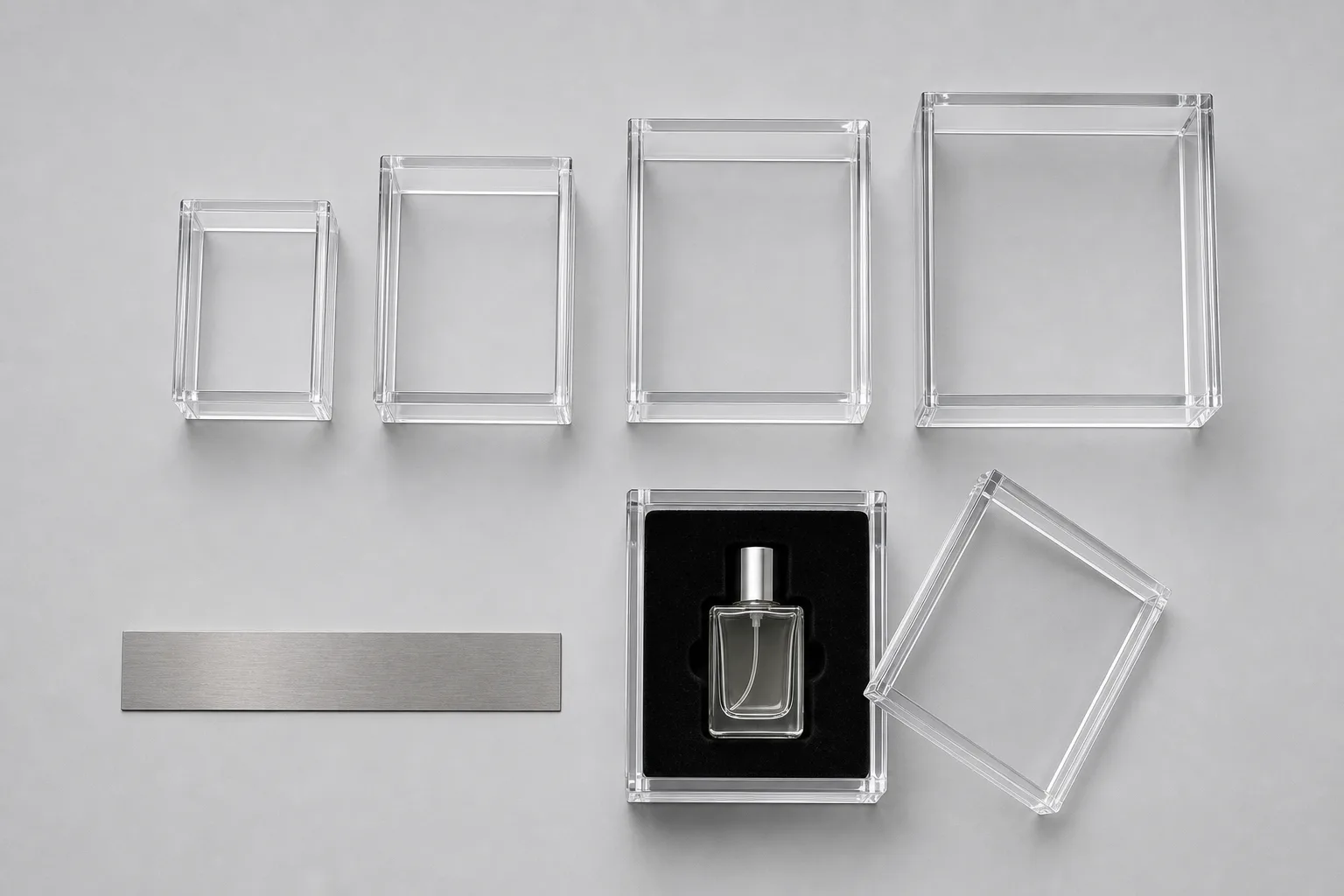
Four bands cover the majority of the acrylic gift box sizes we quote: 8x8x4cm for rings and small favors, 12x12x6cm for cosmetics and bracelets, 15x15x8cm for perfume and candle sets, and 20x20x10cm for multi-item kits. They are working presets, not stocked sizes — any custom dimension runs through the same process at the same MOQ.
| Size band (interior) | Typical contents | Usual thickness | Common lid |
|---|---|:---:|---|
| 8x8x4cm | Rings, earrings, single chocolates, wedding favors | 3mm | Lift-off or hinged (metal piano hinge) |
| 12x12x6cm | Bracelets, compacts, single cosmetics, watch | 3-5mm | Hinged or lift-off |
| 15x15x8cm | Perfume sets, candles, corporate gift sets | 5mm | Hinged |
| 20x20x10cm | Multi-item kits, award + pen + card sets | 5-8mm | Hinged or sliding drawer |
| 25x10x5cm and up | Chocolate assortments, tea flights, long-format sets | 5mm | Sliding drawer |
Because there's no mold, there's no penalty for leaving the bands. A 13.5x11x7cm box costs what the material and cutting time cost — the same math as a 12x12x6cm box. So the bands earn their place a different way: they're proven proportions. A box that's much wider than it is tall reads as a tray; one much taller than wide tips when the lid opens. If your product fits a band within a centimeter, take the band; if it doesn't, spec exactly what the clearance math says and ignore the bands entirely.
The full format range — hinged, lift-off, sliding drawer, and multi-compartment — is laid out on our [acrylic gift boxes](/products/acrylic-boxes/acrylic-gift-boxes/) page, and the wider box family, from display-style cases to five-sided covers, on the [acrylic boxes](/products/acrylic-boxes/) hub.
---
## Wall thickness and lid type follow the size {#thickness-and-lid}
Wall thickness is a consequence of box size, not a separate style choice. Small boxes under about 12cm run 3mm walls; the 12-20cm mid-band runs 5mm; boxes past 20cm or carrying heavy contents step up to 8mm so large unsupported panels stay rigid and the box keeps its premium heft.
Span is the reason. A 3mm panel that feels solid on an 8cm ring box flexes visibly across a 20cm side, and flex is exactly the flimsy-plastic signal a premium gift box exists to avoid. Weight cuts the other way — thicker walls on a big box add real grams fast. Cast acrylic runs about 1.18g/cm³,[^azom] and the panel volume of a 15x15x8cm box works out to roughly 330g in 3mm, 550g in 5mm, and 890g in 8mm. That weight is presence in the hand at one box, and a freight line at 2,000 boxes. The deflection math behind these span limits — how far each thickness bends over each panel size — is worked through in our [acrylic box wall thickness guide](/guide/acrylic-box-wall-thickness-guide/).
Lid mechanisms carry their own size limits. A one-piece acrylic "living hinge" is not something PMMA can do — the material cracks instead of flexing. Hinged lids on gift boxes use small metal piano or barrel hinges, which suit boxes from about 15cm down where a lift-off lid would feel fiddly; larger hinged boxes take a metal piano hinge along the full back edge. Lift-off lids scale to any size but need 0.3-0.5mm of rim clearance per side to seat without binding, and a sliding drawer adds the sleeve: figure roughly an extra 12mm of exterior width and height at 5mm walls plus running clearance, so a drawer box is always noticeably larger outside than its interior suggests.
The interior, not the exterior, is the spec: the insert cavity is cut 1-2mm over the item, the insert body adds 8-12mm per side, and the walls add their thickness outside that. Get the inside right and the outside follows.
---
## Nesting, stacking, and the shipping cube {#nesting-and-freight}
Acrylic gift box sizes set freight cost twice: once as weight and once as volume. International courier and air freight bill by dimensional weight whenever a shipment's volume outruns its actual weight[^dimweight] — and a container of empty rigid boxes is mostly air. Nesting graduated sizes and packing lids flat can cut the shipped cube dramatically.
This is the request behind one of the smarter briefs I've handled: a consumer-goods buyer ordering rigid covers asked us to design the family so each size nested inside the next for the ocean leg. Open-top and five-sided boxes nest naturally if the size steps are planned — each interior must exceed the next box's exterior by a few millimeters of slip clearance. Lift-off lid boxes don't nest assembled, but the lids pack as flat panels beside the bodies. Hinged boxes, once the hinge is mounted, ship assembled — one reason a program that will ship long distances empty sometimes picks lift-off over hinged purely on freight math.
Stacking matters at the destination too. If boxes will stack on a retail counter or in back-stock, flat lids stack cleanly while domed or handled lids don't, and 5mm-plus walls keep a stack of five from bowing the bottom box. Tell us the stack height in the brief and we'll confirm the wall spec covers it.
None of this requires you to do packaging engineering — it requires one sentence in the inquiry: *"empty boxes ship to a US warehouse; optimize the packed cube."* We then plan size steps, lid packing, and carton layout around that, and quote the freight difference so you can see what the nesting design saves.
---
## Fewer sizes, lower program cost: size consolidation {#size-consolidation}
Every distinct size is its own design — its own cutting program, its own insert pattern, its own 50-piece MOQ. Consolidating a five-size wish list into two or three shared sizes spreads setup over larger runs, simplifies inserts, and almost always lowers total program cost more than any per-box negotiation.
The pattern shows up constantly in multi-SKU programs. A cosmetics brand lists five products and asks for five box sizes, each within 15mm of its neighbor. Quoted straight, that's five setups and five insert dies across five short runs. Requoted as two sizes — the small three SKUs sharing one box with SKU-specific insert cavities, the large two sharing another — the same 1,000 units run as two long batches. Unit cost drops meaningfully above 200 pieces per design because setup amortizes, so two 500-piece runs beat five 200-piece runs on arithmetic alone. The insert does the differentiation: one exterior size, five cavity patterns, full shelf-consistency as a bonus.
The test for whether two sizes can merge: if the difference is under 20mm on each axis, one box with per-SKU insert cavities usually covers both. Products with genuinely different formats — a 25cm bottle and an 8cm ring — stay in separate bands; forcing them together wastes more material than a second setup costs. We ran exactly this consolidation for a boutique gift retailer's rollout — the size rationalization and reorder cadence are documented in the [acrylic gift box boutique rollout case study](/case-studies/acrylic-gift-box-boutique-rollout/). And if you're still weighing rigid acrylic against paperboard at the program level, the cost-per-use comparison lives in our [acrylic vs cardboard gift box guide](/guide/acrylic-vs-cardboard-gift-box-buyer-guide/).
---
## From size spec to quote {#size-spec-to-quote}
A complete size brief fits in five lines: the item's dimensions, the fit style (bare, foam insert, or velvet tray), interior dimensions from the clearance math, any fixed exterior constraint, and quantity per size. With those five lines we quote within 24 hours, and a sample ships in 3-5 days to prove the fit before production.
Write it like this and nothing gets lost in translation:
| Brief line | Example |
|---|---|
| Item | Candle jar, 90mm dia x 110mm tall, 480g |
| Fit style | Die-cut foam insert, black |
| Interior (ID) | 110 x 110 x 125mm |
| Exterior constraint | Must fit 130mm shelf pitch — OD max 128mm wide |
| Quantity | 500 pcs, one size |
The sample stage is where size specs become physical fact. You receive the actual box with the actual insert, drop your product in, and feel the fit — snug, rattling, or binding — before any bulk cutting starts. Production follows in 15-20 days after sample approval, every box passing 100% inspection in our ISO 9001-certified factory, shipped FOB Shenzhen with CIF and DDP available. If your product is genuinely hard to measure — irregular ceramics, soft goods, mixed sets — mail us one unit and we'll take the dimensions ourselves and size the box around it. [Send us your product's dimensions](/contact/) and we'll turn them into a box spec, a sample, and a quote — in that order.
[^azom]: [AZoM — PMMA properties](https://www.azom.com/article.aspx?ArticleID=788) — density ~1.18 g/cm³, the figure used in this guide's box-weight estimates across wall thicknesses.
[^dimweight]: [FAQ: How Do I Calculate Dimensional Weight? — eFulfillment Service](https://www.efulfillmentservice.com/2012/11/how-to-calculate-dimensional-weight/) — fulfillment-industry explainer of carrier dimensional-weight pricing, under which parcel and air freight bill by package volume when it exceeds actual weight — the reason nesting and flat-packed lids cut the freight cost of empty rigid boxes.