---
title: "Acrylic Frame Mounting: 4 Methods Compared"
description: "Acrylic frame mounting compared: wall standoffs, magnetic two-piece frames, easel backs, and French cleats — weight limits, wall types, art-change frequency."
category: "Buyer Guide"
author: "Amy Liu"
authorCredential: "Client Account Manager at Wetop Acrylic — coordinating B2B orders from first inquiry through delivery since 2020, 500+ custom projects handled"
datePublished: 2026-07-17
dateModified: 2026-07-17
primaryKeyword: "acrylic frame mounting"
url: https://wetopacrylic.com/guide/acrylic-frame-mounting-methods/
---
## Four mounting methods, one vocabulary trap {#four-methods}
Acrylic frame mounting comes down to four methods: wall standoffs, magnetic two-piece frames, easel backs, and French cleats. They differ in weight capacity, wall requirements, and — most importantly — how fast the artwork inside can change. Choosing well means matching the method to the art-change schedule, not just to the wall.
Here is the vocabulary trap I see weekly: a buyer writes asking for "wall-mounted acrylic frames," and it turns out three different people at their company mean three different things. The marketing lead pictures floating prints on polished standoffs. The store-operations manager means menu panels that staff can swap every Monday without a screwdriver. Facilities means anything that will not put sixteen holes in a leased wall. All of them said "wall mounting." I get this exact question from new buyers 2-3 times a week, and the first thing I ask back is never about the frame — it is "how often does the artwork change, and whose wall is it?"
| Method | Art change | Wall | Typical formats | Drilling | Look |
|---|---|---|---|---|---|
| Wall standoffs | Minutes, needs tool | Any, anchored | A4 to ~60 x 90 cm | 4+ holes | Premium floating |
| Magnetic two-piece | Seconds, no tool | Wall or none | A5 to ~A2 | 2-4 holes or none | Clean sandwich |
| Easel back / desktop | Instant | None | A6 to ~A3 | None | Counter display |
| French cleat | Minutes | Studs / masonry | 60 x 90 cm and up | Cleat rail | Flush, hidden |
This guide compares all four so you can spec the right one per location — and because they are order-time decisions. Every method here is machined or bonded into the frame during production; none retrofit well. For the install-day side — anchors, weight math, hardware stacks — see our companion guide on [how to hang acrylic frames](/guide/how-to-hang-acrylic-frame/). This one is about choosing the method before you order.
---
## Wall standoffs: the permanent statement {#standoff-mounting}
Standoff mounting clamps the acrylic through four (or more) pre-drilled corner holes with metal barrels screwed into wall anchors, holding the frame 15-25 mm off the wall. It is the most architectural of the acrylic frame mounting options — a floating panel with visible polished hardware — and the least convenient to re-open.
The mechanics are simple: a barrel carries the load into the wall anchor, a threaded cap clamps the acrylic face, and the offset creates the shadow gap that makes the panel float. Because the panel is clamped at drilled points rather than hung from a hook, standoffs handle mid-size frames with confidence and keep them dead flat against warping.
What buyers underestimate is the change cycle. Swapping the print in a standoff frame means unscrewing four caps — a step stool, a few minutes, and two hands per frame. For a lobby brand statement or a diploma wall on our [certificate frame](/products/acrylic-frames/acrylic-certificate-frames/) format, that is irrelevant; the content never changes. For a merchandising wall that rotates monthly across 40 stores, those minutes multiply into a labor line item, and a magnetic format starts paying for itself.
Two specification notes from 6+ years of coordinating frame orders. First, hole position tolerance matters more than hole count: four holes CNC-drilled to the drawing means the wall template matches every frame in the batch — and hole position is one of the things our QC team checks piece-by-piece during 100% inspection, because a missing or drifted mounting hole is the kind of defect that stops an entire installation crew. Second, specify the standoff finish with the frame, not after: satin stainless, black, and brass barrels all read differently against a polished acrylic edge.
---
## Magnetic two-piece: built for rotation {#magnetic-mounting}
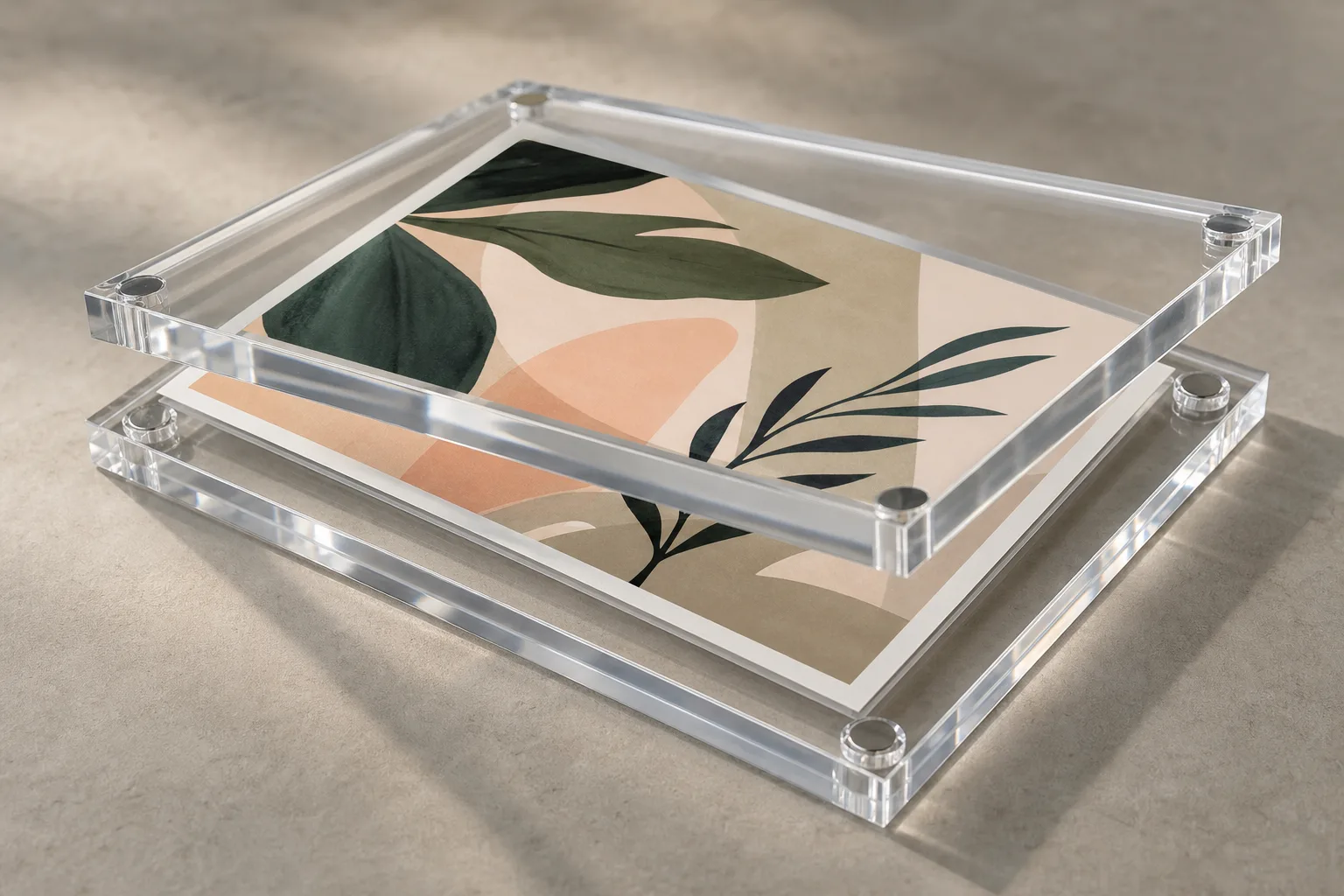
A magnetic acrylic frame is two panels — a back and a face — that sandwich the print and grip each other through embedded neodymium magnet pairs. Opening it takes seconds and no tools, which makes it the default acrylic frame mounting method wherever artwork changes on a schedule: menus, price cards, galleries, campaign walls.
The engineering variable is the magnets themselves. Neodymium magnets are graded by N number, and the grade tracks the magnet's stored magnetic energy — an N52 magnet is measurably stronger than an N35 of the same size, and the grade-to-strength relationship is well documented by magnet suppliers.[^magnet-grades] A two-piece frame distributes that grip across multiple pairs around the perimeter: more pairs and higher grades for larger, heavier faces; fewer for a desktop 5 x 7. We spec grade, diameter, and count against the face-panel weight at order time, then verify the grip feel on the pre-production sample — firm enough to hold, light enough that staff can open it one-handed.
Wall-mount versions hang from two to four discreet screws through the back panel (or sit on adhesive within its rating — more on that below), while the magnetic sandwich handles all the opening and closing. That split is the method's core advantage: the wall hardware is installed once, and every art change afterward touches only the magnets.
If your program is specifically menu- or print-rotation driven, our [magnetic acrylic frames](/products/acrylic-frames/acrylic-magnetic-frames/) page covers the format options, and the [magnetic picture frames buyer guide](/guide/magnetic-picture-frames-buyer-guide/) goes deeper on that product family. Magnet placement is embedded during fabrication — recessed and capped so nothing telegraphs through the visible face — so it has to be on the drawing before production, like every other detail on this list.
---
## Easel backs and desktop formats: no wall at all {#easel-desktop}
An easel-back or desktop acrylic frame skips the wall entirely: a hinged leg, a slanted block, or an L-shaped profile holds the frame on a counter, shelf, or desk. It is the zero-commitment acrylic frame mounting method — no drilling, no adhesive, instant repositioning — and the right answer for retail counters and reception desks.
The three desktop constructions behave differently. A slant-back L-frame is a single bent piece with the print dropped in from the top — the most economical construction, the fastest to reload, and the standard for price cards and countertop signage. A block easel is a thick machined base with a slot; it reads premium and stays put, which suits jewelry counters and award displays. A hinged easel back mimics a photo frame and folds flat for shipping.
Size discipline is the one real constraint. Past roughly A3, a freestanding acrylic frame becomes tip-prone in traffic and takes up counter real estate that retail managers guard jealously; large formats belong on a wall. The other planning note is packaging: desktop frames often ship to dozens of locations individually, so a fold-flat or slot-assembled design can cut the freight bill meaningfully — worth raising at quote stage, because as a made-to-order fabrication decision it costs nothing to change on the drawing.
When I walk a first-time retail buyer through format choice, the pattern that recurs: wall formats for brand permanence, desktop formats for point-of-sale flexibility — and most rollout programs order both against one artwork spec.
---
## French cleats: the large-format answer {#french-cleat}
A French cleat hangs a large acrylic frame from two interlocking 45-degree rails — one bonded to the frame's back, one anchored level across the wall. The frame's weight seats the rails together, spreading the load along the full rail length. For frames from roughly 60 x 90 cm up, this is the acrylic frame mounting method that scales.
A French cleat in cross-section: the wall rail is anchored once, level; the frame rail is bonded to the acrylic back panel during fabrication; gravity seats the mirrored 45-degree faces and spreads the frame's weight along the whole rail.
Weight is why. Cast acrylic runs about 1.2 g/cm³,[^plexiglas-density] and large frames use two panels at greater thickness to stay flat — so a 60 x 90 cm frame with two 4.5 mm panels already carries roughly 5.8 kg (about 13 lb) of acrylic before the print. Point-load methods concentrate that on four small anchors; a cleat distributes it along a rail landing on studs or masonry anchors. The result hangs flush, hides all hardware, lifts on and off for art changes without touching the wall, and self-levels side to side during install.
The cleat itself can be aluminum or acrylic, bonded to the back panel during fabrication. That bond is a structural joint, so it follows the same quality rules as any load-bearing acrylic bond — full wet-out, stress-relieved parts — and it is checked at inspection like one. Galleries running rotating exhibitions are the classic cleat users: our [floating acrylic frames](/products/acrylic-frames/acrylic-floating-frames/) build on cleat backs for exactly that use, and the [colored acrylic floating frames case study](/case-studies/colored-acrylic-floating-frames-art-galleries/) shows the format in a real gallery program.
---
## Renters and no-drill walls: know the ceiling {#no-drill}
No-drill acrylic frame mounting means adhesive strip systems — and their published weight ratings are the hard ceiling. A set of 3M's large picture-hanging strips is rated to 15 lb (about 6.8 kg),[^command-strips] which covers small and mid-size acrylic frames comfortably and large two-panel formats not at all.
Run the arithmetic before promising anything to a landlord. Frame weight is length x width x total panel thickness x density: a 40 x 50 cm frame with two 3 mm panels is about 1.4 kg (3.1 lb) — deep inside any strip rating. The 60 x 90 cm two-panel frame from the cleat section is roughly 5.8 kg (13 lb) — technically inside a 15 lb rating, but with almost no margin for the print, humidity cycling on the adhesive, or an imperfect wall surface. My rule when a buyer tells me the location is leased: strips for anything under about half the published rating, easel or freestanding formats for the rest, and drilling only with the landlord's sign-off in writing.
Two practical notes. Adhesive systems want smooth, painted, clean walls — textured and porous surfaces cut real capacity below the printed rating. And a magnetic two-piece frame pairs well with strips: install the light back panel on adhesive once, and every art change afterward happens through the magnets, never stressing the adhesive with removal cycles.
The magnetic two-piece swap: the face panel lifts off by hand, the print changes in seconds, and the wall hardware is never touched. For rotation-heavy programs, this is the labor math that decides the mounting method.
---
## The decision framework {#decision-framework}
Choosing an acrylic frame mounting method takes three questions in order: how often does the art change, what does the frame weigh, and can you drill the wall? Answer those and the method usually picks itself — the table below maps the common scenarios.
| Your scenario | Method | Why |
|---|---|---|
| Lobby brand statement, art never changes | Standoffs | Premium floating look; change speed irrelevant |
| Restaurant menus, weekly rotation | Magnetic two-piece | Tool-free swap in seconds, staff-proof |
| Retail counter price cards | Easel / slant-back | No wall, instant reposition, easy to multiply |
| Gallery exhibition wall, monthly rotation | French cleat (+ magnetic faces) | Big formats lift on and off; wall drilled once |
| Leased office, no drilling allowed | Adhesive strips within rating, or easel | 15 lb per strip-set ceiling; compute weight first |
| Diploma / certificate program | Standoffs | Permanent, uniform install across a wall grid |
| 50-store campaign wall rollout | Magnetic two-piece, template-drilled backs | One wall template, seconds per art change forever |
Mixed programs are normal — in 6+ years of coordinating rollouts I have rarely shipped a program that used only one method. The useful discipline is per-location specification: the same artwork can ship as a standoff frame for the flagship, magnetic frames for the mall stores, and easel formats for counters, all from one drawing set and one production run.
---
## Ordering: mounting is a production spec {#ordering}
Every acrylic frame mounting method is built into the frame during production — drilled, embedded, or bonded — so the mounting decision belongs in the RFQ, not the unboxing. The good news: on CNC-cut acrylic these are program changes with zero tooling fees, and changing hole positions between orders costs nothing but a drawing revision.
What we need per format: for standoffs — frame size, panel thicknesses, hole diameter and inset, barrel finish; for magnetic — face size and how often staff will open it, so we spec magnet grade and count; for easel — the construction type and counter depth; for cleats — frame weight and wall type, so the rail and anchors match. Send what you have to our [acrylic frames](/products/acrylic-frames/) team even if it is a photo and a wall dimension — full drawings are welcome but not required, and every mounting option on this page is part of our standard [customization](/customization/) scope.
The commercial frame: MOQ 50 pieces per design, samples in 3-5 days, production in 15-20 days, FOB Shenzhen. Each order gets a digital proof with every hole and magnet position dimensioned, then a physical sample; bulk production is checked piece-by-piece against that sample — mounting details included — before it ships. [Send us your frame spec](/contact/) and tell us whose wall it is going on; we respond within 24 hours.
[^magnet-grades]: [Magnet Grades — K&J Magnetics](https://www.kjmagnetics.com/blog/magnet-grade) — explains the neodymium N-grade system, showing that the N number tracks maximum energy product and that higher grades like N52 are proportionally stronger than N35 at the same magnet size; the basis for magnet-grade selection in two-piece frames.
[^plexiglas-density]: [MakeItFrom — Polymethylmethacrylate (PMMA, Acrylic)](https://www.makeitfrom.com/material-properties/Polymethylmethacrylate-PMMA-Acrylic) — published PMMA density of ~1.2 g/cm³, the number behind the panel-weight math here.
[^command-strips]: [Command Large Picture Hanging Strips — 3M](https://www.command.com/3M/en_US/p/d/b5005604172/) — manufacturer product page publishing the 15 lb per-set weight rating cited as the hard ceiling for no-drill adhesive mounting of acrylic frames.