---
title: "Acrylic Awards Under $20: Bulk Trophy Math for HR Programs"
description: "Acrylic awards under $20 are achievable for most HR recognition programs at 100+ units. Five styles, five volume tiers, and the per-unit pricing math behind each."
category: "Buyer Guide"
author: "Amy Liu"
authorCredential: "Client Account Manager at Wetop Acrylic — coordinating B2B orders from first inquiry through delivery since 2020, 500+ custom projects handled"
datePublished: 2026-05-05
dateModified: 2026-05-05
primaryKeyword: "acrylic awards under $20"
url: https://wetopacrylic.com/guide/acrylic-awards-under-20-hr-program-pricing/
---
## Why $20 Per Unit Is the Recognition-Program Sweet Spot {#why-20-dollar}
Twenty dollars per unit is where most HR recognition programs land because it sits in the budget zone where peer-recognition and quarterly-performer awards are funded across the year. SHRM's recognition-program research shows companies typically budget $11–$18 per peer-recognition award and $20–$50 per service-anniversary award[^shrm-recognition]. Acrylic awards under $20 cover the upper end of the peer-tier and the lower end of the service-tier with one specification — which is exactly what makes them efficient to procure.
I get this exact question from new HR buyers about three times a month — "can we do something nicer than a paper certificate, but stay under $20 per unit?" The answer is almost always yes, but the path depends on volume and personalization scope. A 50-unit run with full logo + name + year engraving on an elaborate shape is going to land at $22–$28. The same engraving on the same shape at 250 units lands at $14–$18. The math problem is volume, not aesthetics.
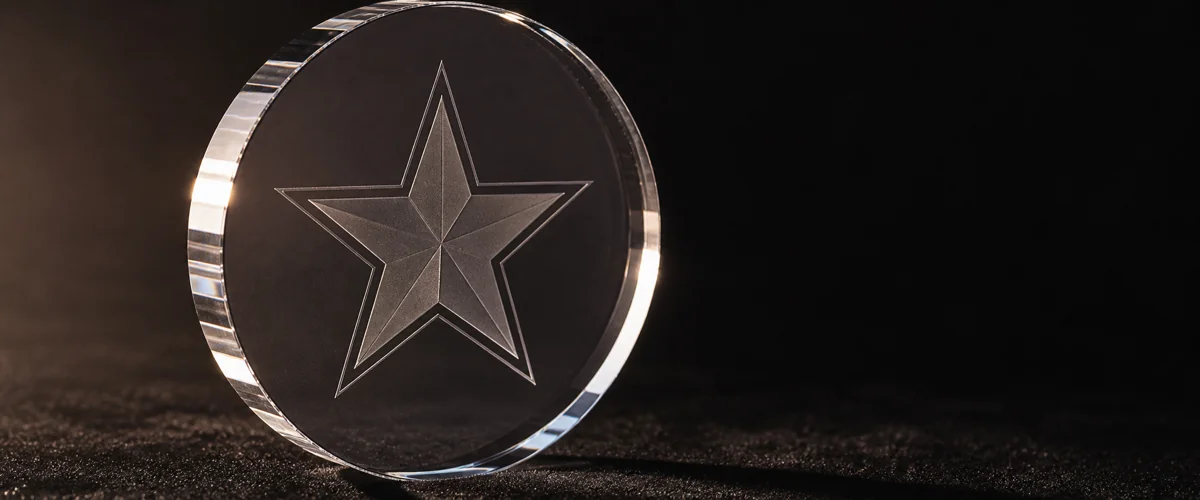
Engraved PMMA awards staged for a quarterly recognition event. At 250-unit volume with logo + name + year personalization, this exact format lands inside the under-$20 budget-tier.
The psychological reason $20 is the sweet spot: it's high enough that the recipient perceives the award as a real object worth keeping (Gallup's research on recognition impact ties perceived value directly to engagement lift)[^gallup-recognition], but low enough that finance signs off on a 250-unit program in one purchase order instead of treating each award as a discretionary expense. Procurement loves predictable line items. A $19.50 unit cost across 250 pieces is one $4,875 line item — easy to approve, easy to forecast next year.
---
## Tiered Pricing — What 50, 250, and 1,000 Unit Orders Cost {#tiered-pricing}
The per-unit price on a custom acrylic award drops by roughly 35–50% as you scale from 50 units to 1,000 units. The reason is the same setup-cost math that drives every custom-manufacturing run: laser-engraving setup, polishing-fixture prep, and QC staging are largely fixed, so they amortize down as quantity rises. Below is the actual tiered pricing matrix Wetop quotes most often for HR programs sourcing under-$20 acrylic awards.
Tiered pricing matrix — five common award styles × five volume tiers. Prices are per-unit USD with logo + name + year laser engraving included. FOB Shenzhen.
Award Style
50 units
100 units
250 units
500 units
1,000 units
Flat Plaque (5×7", 8mm)
$17.50
$14.20
$11.80
$10.40
$9.20
Standing Rectangle (4×6", 15mm)
$19.80
$16.10
$13.40
$11.70
$10.30
Star Cut (5" point-to-point, 12mm)
$21.50
$17.90
$14.80
$12.90
$11.40
Diamond / Faceted (4" tall, 20mm)
$24.20
$19.40
$16.20
$14.10
$12.50
Custom-Cut Logo Shape (within 5×5", 12mm)
$26.80
$21.30
$17.60
$15.30
$13.50
Volume discount from 50→1,000 units averages 47% per-unit. The 250-unit tier crosses the under-$20 threshold for every style; the 100-unit tier crosses it for three of five.
A few things to read from this matrix. First, the under-$20 acrylic awards target is met at 100 units across most styles — only the diamond and custom-cut shapes need 250 units to clear the line. Second, the gap between 250 and 500 units is about 12–14% per unit; the gap between 500 and 1,000 is around 11–12%. The marginal saving keeps shrinking, which is why most HR programs settle into 250–500 unit annual orders rather than chasing the 1,000-unit price.
In 6+ years of pricing HR programs I've seen the same buyer pattern repeat: a first-time buyer asks for 50 units, sees the per-unit number, then realizes the annual program actually needs 250–300 across the year and re-quotes at the higher tier. The conversation resets to the right volume. If you're at the briefing stage now, save yourself the round trip — quote at the volume that matches your actual annual headcount, not your first-event headcount.
---
## Customization Tradeoffs — Logo + Name + Year vs. Blank {#customization-tradeoffs}
Personalization is the second-largest cost driver behind volume, and the math changes meaningfully depending on what you engrave. A blank acrylic award with no engraving is roughly $2–$4 per unit cheaper than the fully personalized version at the same shape and volume. Add a logo only, you give back $1.20–$1.80 of that saving. Add a name and year on top, you give back the rest. The good news for HR programs: at 250+ unit volume, full personalization (logo + name + year) adds only about $1.50–$3.00 per piece, because the laser-engraving setup amortizes across the run.
The cost moves are not linear, though, which is the trap for first-time buyers. At 50 units the same logo + name + year customization adds $3.00–$5.00 per piece — nearly double the 250-unit premium. The reason is that the engraving programming, font-matching, and proof-approval cycle takes the same time whether we're engraving 50 awards or 250. When my engraving team sets up a new file, they spend roughly 45 minutes on the proof regardless of run length. At 50 units that's almost a minute of setup labor per piece; at 250 units it's eighteen seconds.
### What customization options actually cost at 250-unit volume
| Personalization | Per-unit add-on | Lead time impact |
|---|---|---|
| Blank — no engraving | baseline | none |
| Logo only (single-color laser) | +$0.80 | +1 day proof approval |
| Logo + employee name | +$1.40 | +2 days name-list confirmation |
| Logo + name + year | +$1.80 | +2 days name-list confirmation |
| Logo + name + year + UV-printed accent color | +$3.50 | +3 days proof approval |
| Two-sided engraving (front + back) | +$2.20 | +1 day setup |
The decision I steer most HR buyers toward: skip the UV-printed accent color unless the brand identity demands it. Single-color laser engraving on clear or frosted PMMA looks premium, reads cleanly across years of use, and stays inside the under-$20 budget at 250+ volume. Adding a printed accent color tips most styles over the line and adds a proof revision cycle that doesn't help engagement materially.
For programs where the recognition piece needs more visual presence — say, a top-of-year executive award or a major service-anniversary milestone — the calculus changes. That's where hybrid joinery (acrylic + wood base) earns its premium and where the budget moves to $35–$60 per piece. We covered the hybrid construction in detail in our [wood and acrylic awards hybrid joinery guide](/guide/wood-and-acrylic-awards-hybrid-joinery/), and the higher-end embedment options in our [lucite embedment awards buyer guide](/guide/lucite-embedment-awards-buyer-guide/). Both are worth reading if you're tiering recognition with mid-tier and top-tier awards in the same program.
---
## Five Styles Within the $20 Budget — The Practical Menu {#five-styles}
Five award shapes consistently land under $20 at the volumes most HR programs actually order. Each has a different feel, and I've watched buyers regret picking the wrong one for the program more often than the wrong material. The shape carries the message — flat plaques read formal, stars read celebratory, diamonds read milestone. Match the shape to what the recognition is for.
**1. Flat plaque (5×7", 8mm thick).** The most economical entry point. Reads like a corporate recognition piece, photographs well in a simple frame display, and sits flat in shipping cartons (lower freight cost). Best for peer recognition, training-completion certificates, sales-target achievement. At 100 units with logo + name + year, lands around $14.20 per piece.
**2. Standing rectangle (4×6", 15mm thick).** A free-standing piece that displays on a desk or shelf without a holder. Thicker stock gives it visual weight that the flat plaque lacks. Best for quarterly performer awards or new-hire welcome pieces. At 250 units, lands around $13.40.
**3. Star cut (5" point-to-point, 12mm).** Celebratory shape. Reads "achievement" without needing engraved language to make the point. Best for sales contests, top-performer events, fundraising milestones. The point-to-point cut adds a small per-piece time premium versus rectangular shapes, which is why it sits 15% above the flat plaque at the same volume.
**4. Diamond / faceted (4" tall, 20mm).** Milestone shape. The thick stock and faceted edges signal a more significant recognition moment. Best for service anniversaries (5, 10, 15 years) or major individual contributor awards. At 250 units lands at $16.20 — still under $20 with full personalization.
**5. Custom-cut logo shape (within 5×5", 12mm).** A laser-cut profile of the company logo or a signature shape from the brand identity. Highest perceived value of the under-$20 styles because it reads as bespoke, not catalog. Requires a clean vector file (AI, SVG, or DXF). At 250 units lands at $17.60. Below 250 units this style usually breaks the $20 ceiling, which is why I recommend it for annual flagship programs rather than one-off events.
If you're choosing between styles for a multi-tier program, I usually recommend three styles tiered by recognition level: flat plaque for peer recognition (highest volume), standing rectangle or star for quarterly performers (mid volume), diamond or custom-cut for service anniversaries (lowest volume but highest visual weight). The shape gradient reinforces the recognition gradient without anyone needing to read the text.
For full product-line context across plaque, trophy, and recognition formats, see our [acrylic awards collection page](/products/acrylic-awards/) — that's where the format catalog lives, including the engraving and printing options that pair with each style. For a real-world example of how custom-cut acrylic shapes scale from concept to dimensional logo signage, the [3D acrylic letters dimensional logo signage case study](/case-studies/3d-acrylic-letters-dimensional-logo-signage/) walks through the same vector-to-cut workflow that drives the custom-cut logo style.
---
## Annual Program Timing — When to Lock Pricing {#annual-timing}
The single biggest cost lever HR programs control — outside of volume — is when in the year they place the order. Locking annual program pricing in Q4 (October–December) typically saves 8–12% versus rush orders placed inside a 4-week ceremony deadline, because freight rates and factory capacity both tighten in Q1 around Lunar New Year and again in Q3 around the back-to-school / pre-holiday production peak. WorldatWork's salary and recognition trends research notes that mature recognition programs treat the award procurement as an annual budgeted item rather than an event-triggered purchase[^worldatwork-trends] — that procurement discipline is exactly what protects pricing.
Here's the timing pattern I see working for buyers who run multi-event annual programs:
| Event Date | Order Lock Date | Why |
|---|---|---|
| January employee kickoff | Late October | Beats Lunar New Year freight tightening |
| Q1 quarterly awards | Early November | Production fits Dec window before LNY shutdown |
| Service anniversary (rolling) | Lock 12-month forecast in Q4 | Order full annual quantity once, draw down monthly |
| Mid-year sales conference | Late March / Early April | Avoids Q3 capacity tightening |
| Q4 annual gala | June / Early July | 6-month buffer for personalization revisions |
The "service anniversary rolling" pattern is the underrated move. Many HR programs scatter their service-anniversary awards across the year as employees hit their dates, and they re-order in batches of 20–40 several times a year. Each batch carries its own setup cost. A single 250-unit order placed in Q4 at $13.40 per unit, drawn down monthly from a buffer-stock arrangement, beats four 50-unit orders at $19.80 each spread across the same 12 months. The savings on a 250-employee program: roughly $1,600 per year, before counting the procurement-time savings on three fewer purchase orders.
When you're ready to map your annual program to a tiered quote, send us the headcount, the tier structure (peer / quarterly / anniversary), and the calendar of events. The full RFQ approach we recommend is laid out in our [acrylic RFQ guide](/guide/acrylic-rfq-guide/), and for pilot-volume planning before you commit to a 250-unit annual order, our [low MOQ acrylic ordering guide](/guide/low-moq-acrylic-ordering-guide/) covers the 50-piece pilot path.
We have shipped to 25+ countries and delivered 2,000+ custom projects across HR recognition programs, brand merchandise programs, and dealer-incentive programs. The pricing matrix above reflects what we actually quote — not headline pricing that disappears on the fine print. If your annual program is in planning right now and you want a tiered quote that maps to your headcount and event calendar, that's a 24-hour turnaround with us.
## Related guides
- [Deposit vs Full Payment in Custom B2B Acrylic Production](/guide/deposit-vs-full-payment-custom-acrylic/)
- [Repeat-Order Acrylic Lead Time — Why Wetop's Tooling Library Cuts 30%](/guide/acrylic-repeat-order-tooling-library/)
[^shrm-recognition]: [SHRM (Society for Human Resource Management) — Employee Recognition Programs](https://www.shrm.org/topics-tools/news/employee-relations/employee-recognition-programs) — SHRM is the largest professional HR association in the United States. Their recognition-program research informs the typical $11–$18 peer-award and $20–$50 service-anniversary budget bands referenced in this guide.
[^gallup-recognition]: [Gallup — The Power of Recognition (Workplace Research)](https://www.gallup.com/workplace/236441/employee-recognition-low-cost-high-impact.aspx) — Gallup's longitudinal workplace research ties perceived recognition value directly to engagement and retention outcomes. The "perceived as a real object worth keeping" psychological frame in this guide draws on their findings that tangible recognition outperforms equivalent-cost cash bonuses in retention impact.
[^worldatwork-trends]: [WorldatWork — Total Rewards and Recognition Trends](https://worldatwork.org/) — WorldatWork is the professional association for total-rewards and recognition practitioners. Their annual trends research documents the shift among mature recognition programs toward annual budgeted award procurement, supporting the Q4-lock timing strategy referenced in this guide.